Handit
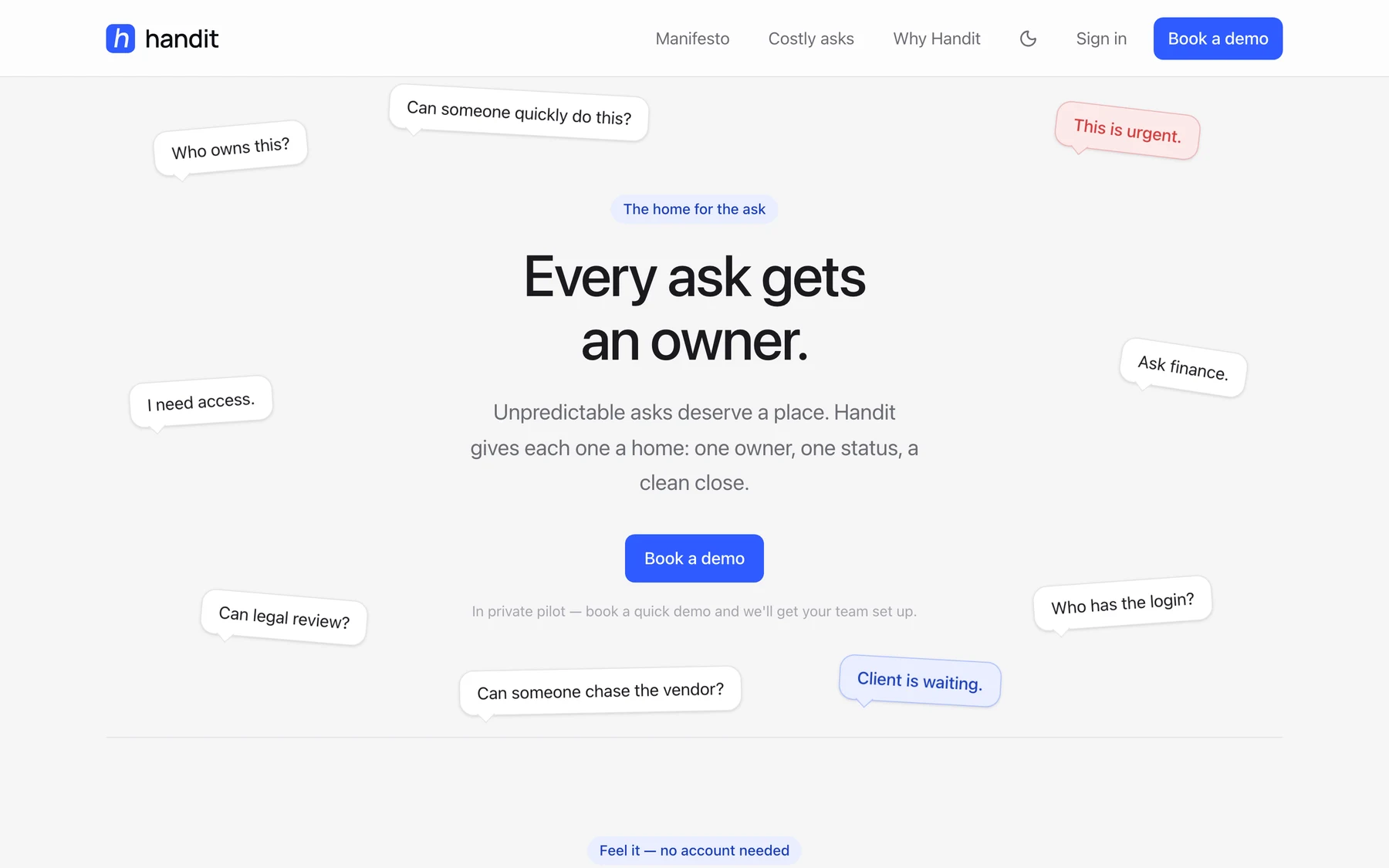
A home for the small requests that get lost at work. Every ask gets one owner, one status, and a clean close.
- the problem
- Small requests at work get lost in Slack, email, and Teams, and people end up chasing each other with “any update?”
- what I made
- A web app that gives every ask one owner, one status, and a clean close, plus its name, logo, voice, website, manifesto, and pitch deck.
- where it lives now
- In private pilot. handit.to
what it is
At work, the smallest requests cause the most chasing.
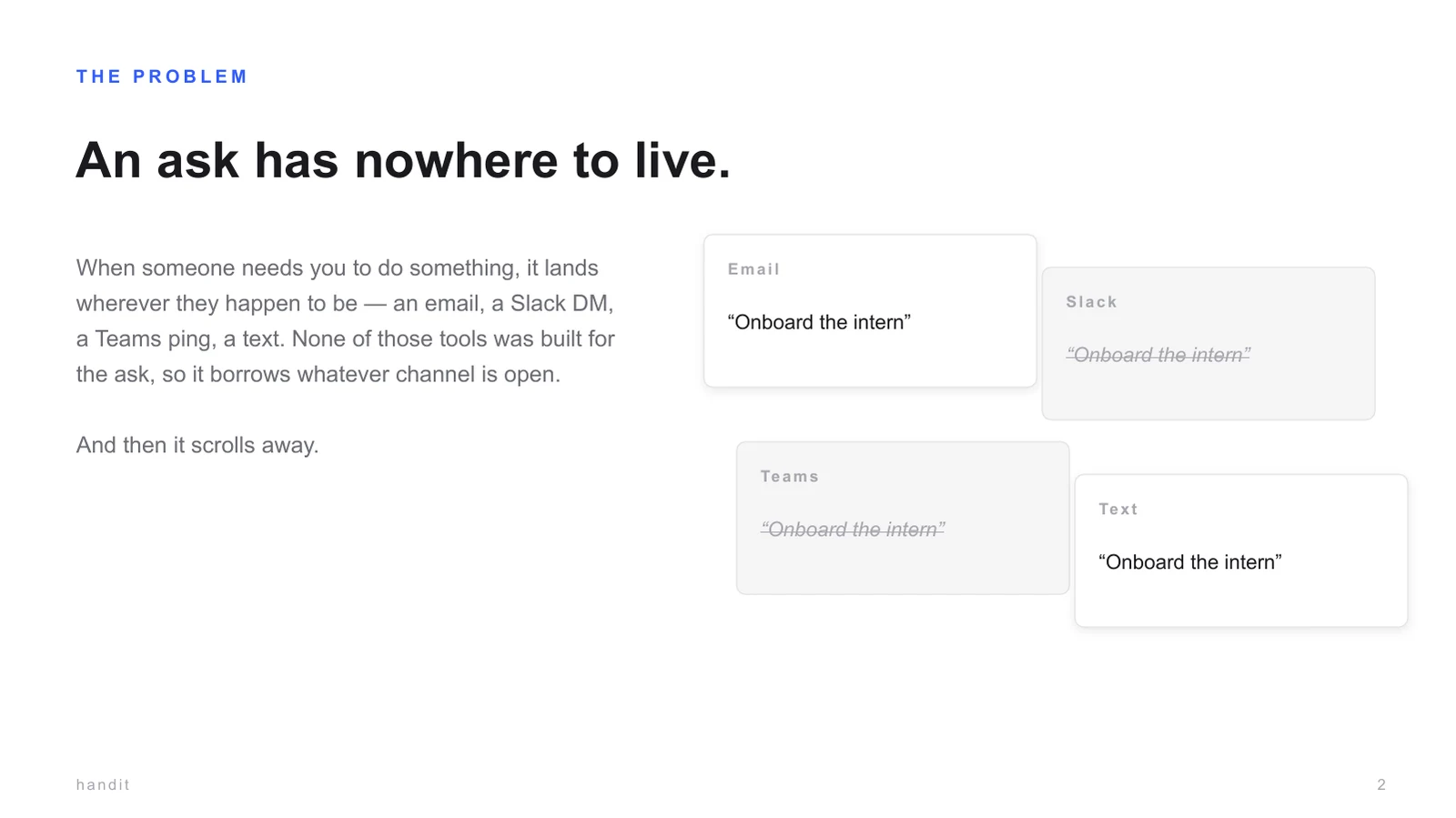
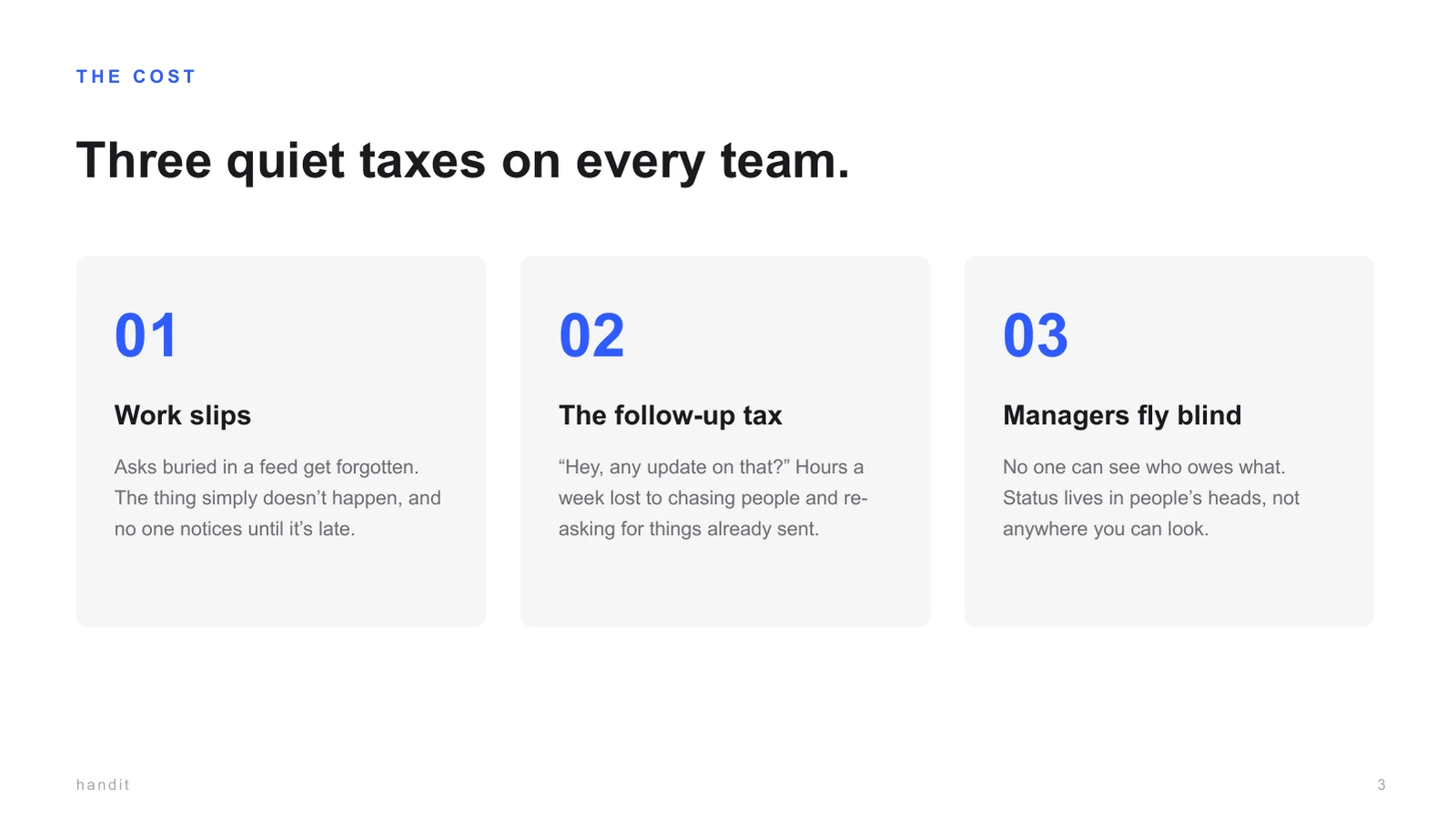
“Can you review this?” “Who can give me access?” “Can Finance approve the invoice?” Asks like these land in Slack, email, Teams, and texts. None of those tools was built to track them, so they scroll away. A few days later, someone writes, “Any update?”
Handit gives each ask a home. You drop it in one line. The right person accepts it. You can see where it stands without chasing, and when it’s done, it closes.
It’s small on purpose. Not chat, not email, not a project tool. Just asks.

the strategy
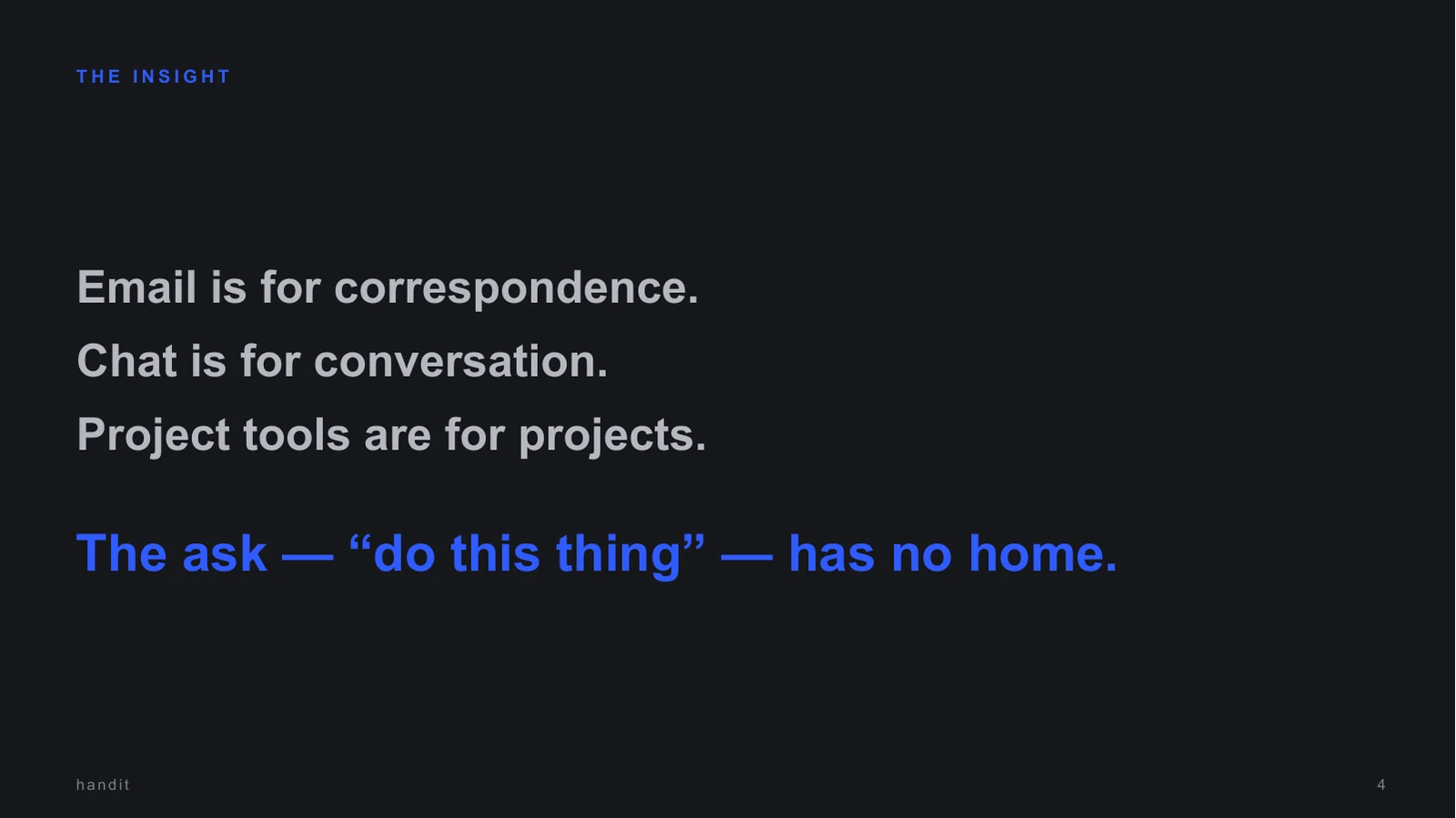
Email is for correspondence.
Chat is for conversation.
Project tools are for projects.
The ask, “do this thing,” has no home.
The insight slide from my pitch deck, and the whole strategy in four lines.
-
Own one thing.
Handit handles the ask and refuses everything else: no projects, boards, threads, subtasks, or custom fields. The restraint is the product.
-
Make ownership explicit.
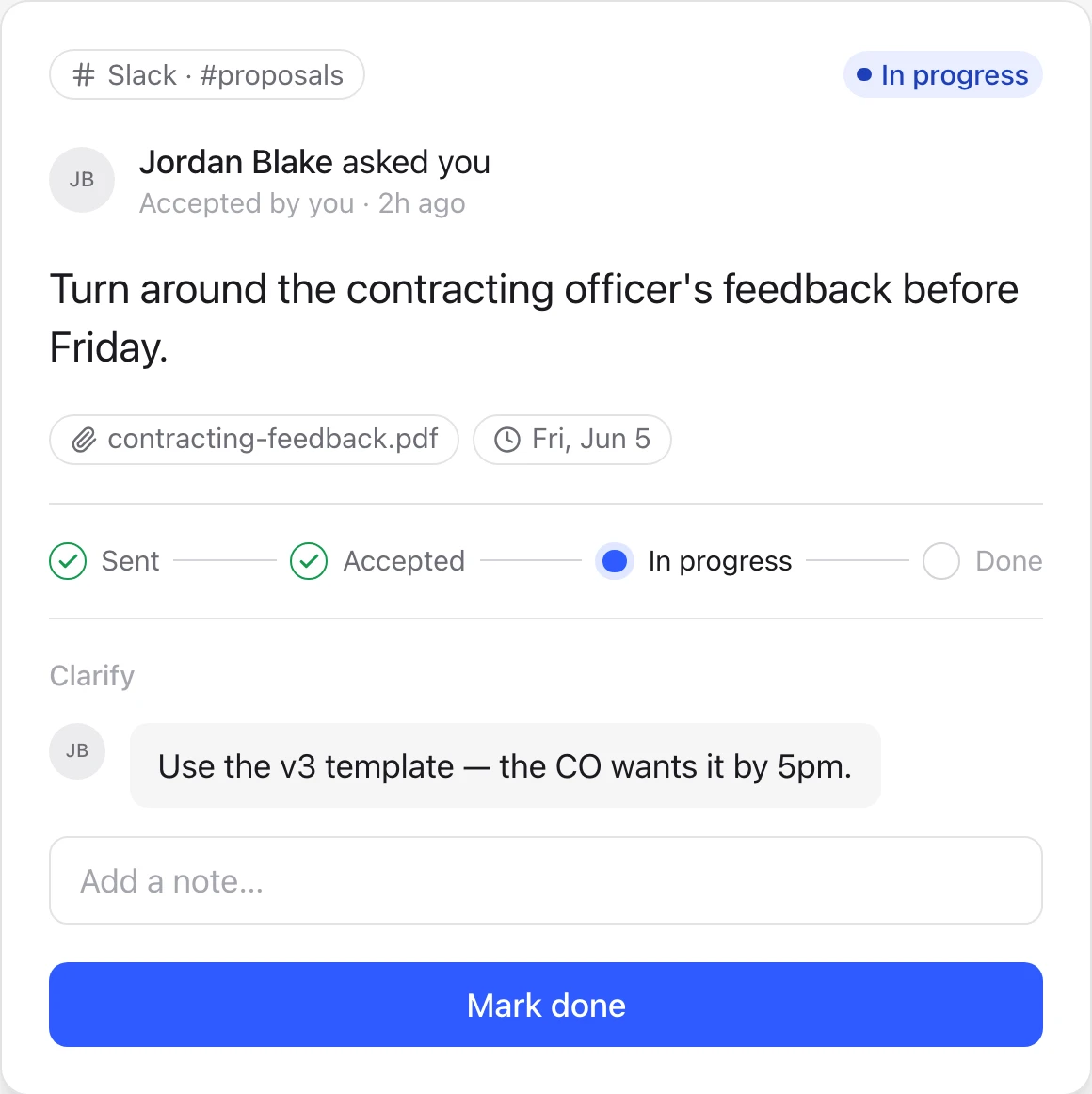
An ask isn’t real until its owner taps Accept. That one tap ends a classic mix-up at work: the sender thinks it’s handled, and the receiver thought it was a suggestion.
-
Meet people where they work.
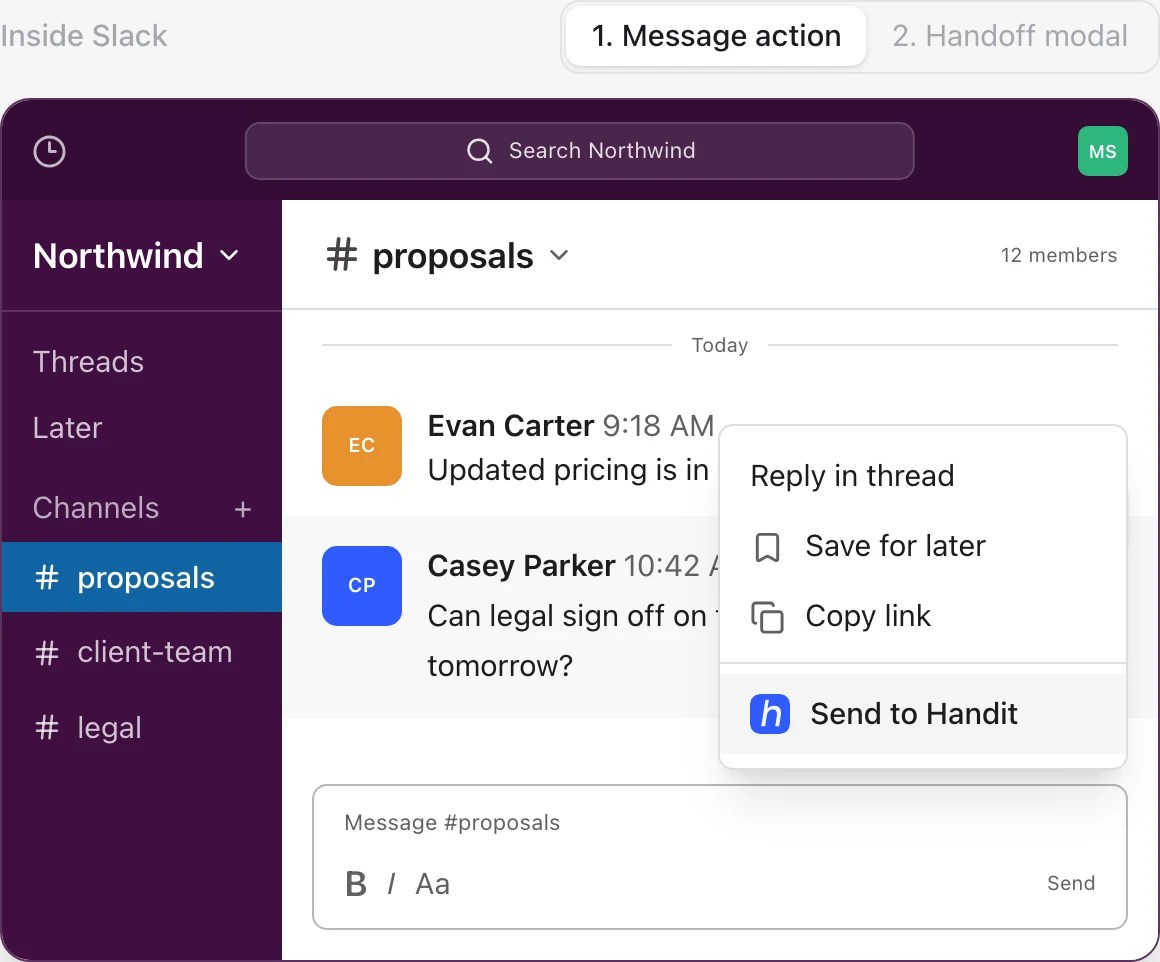
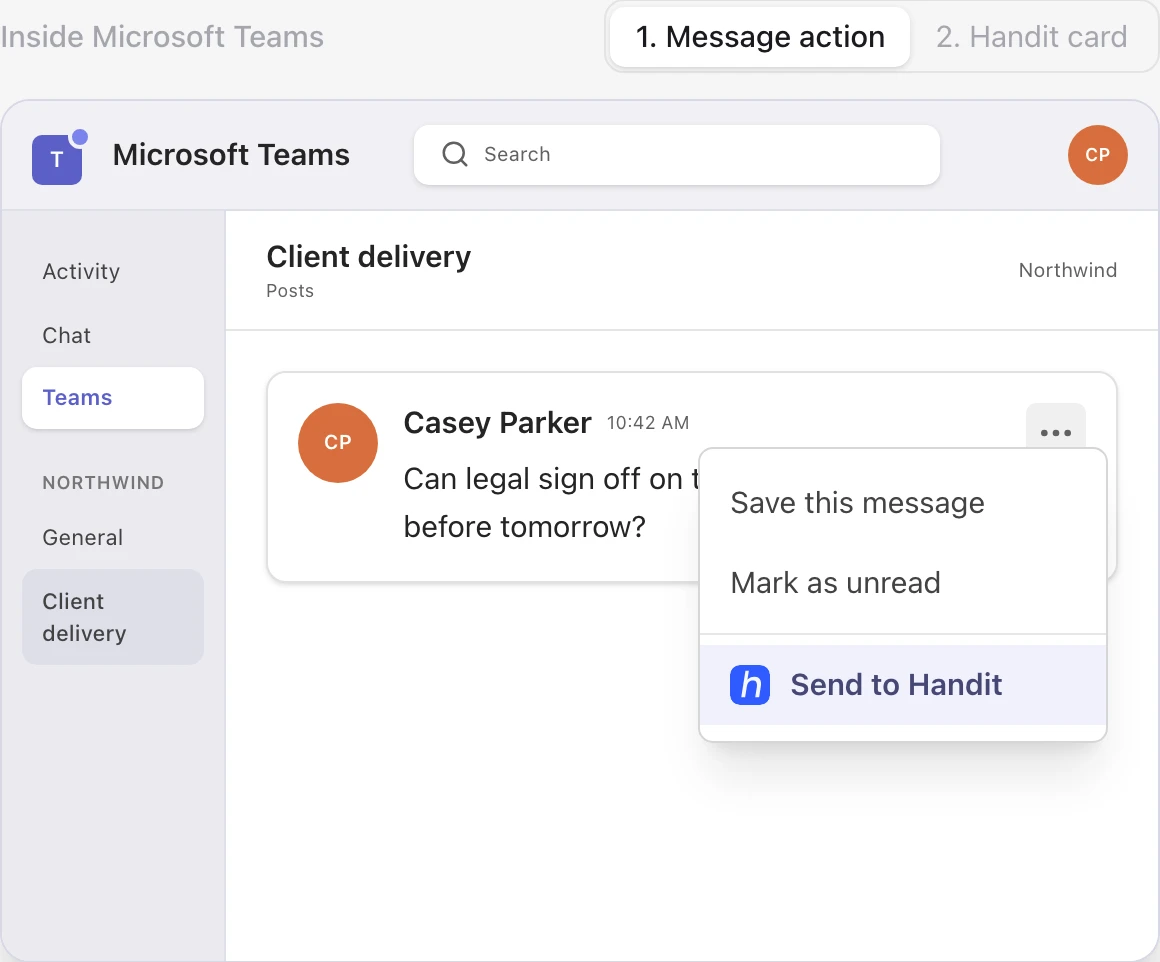
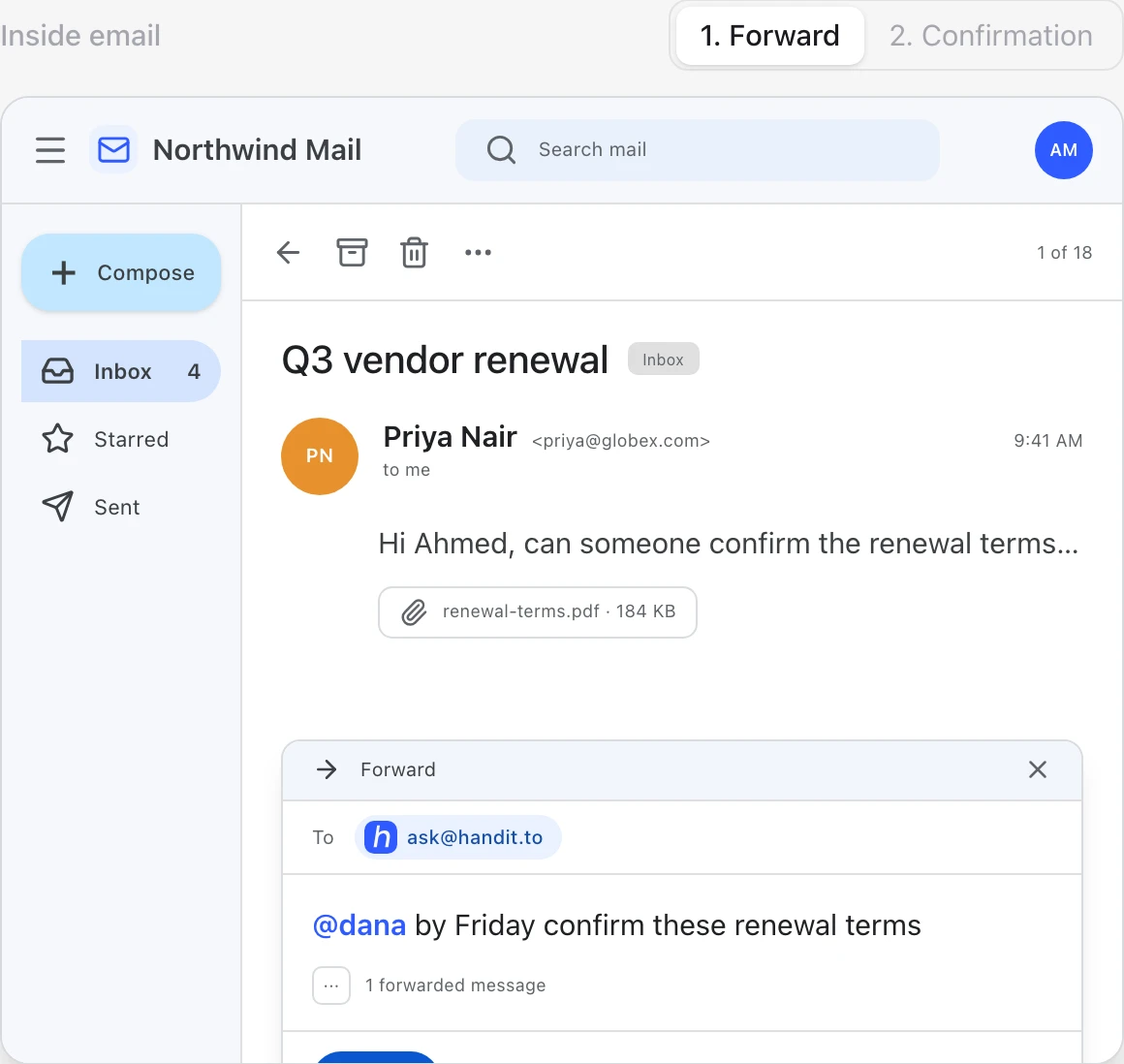
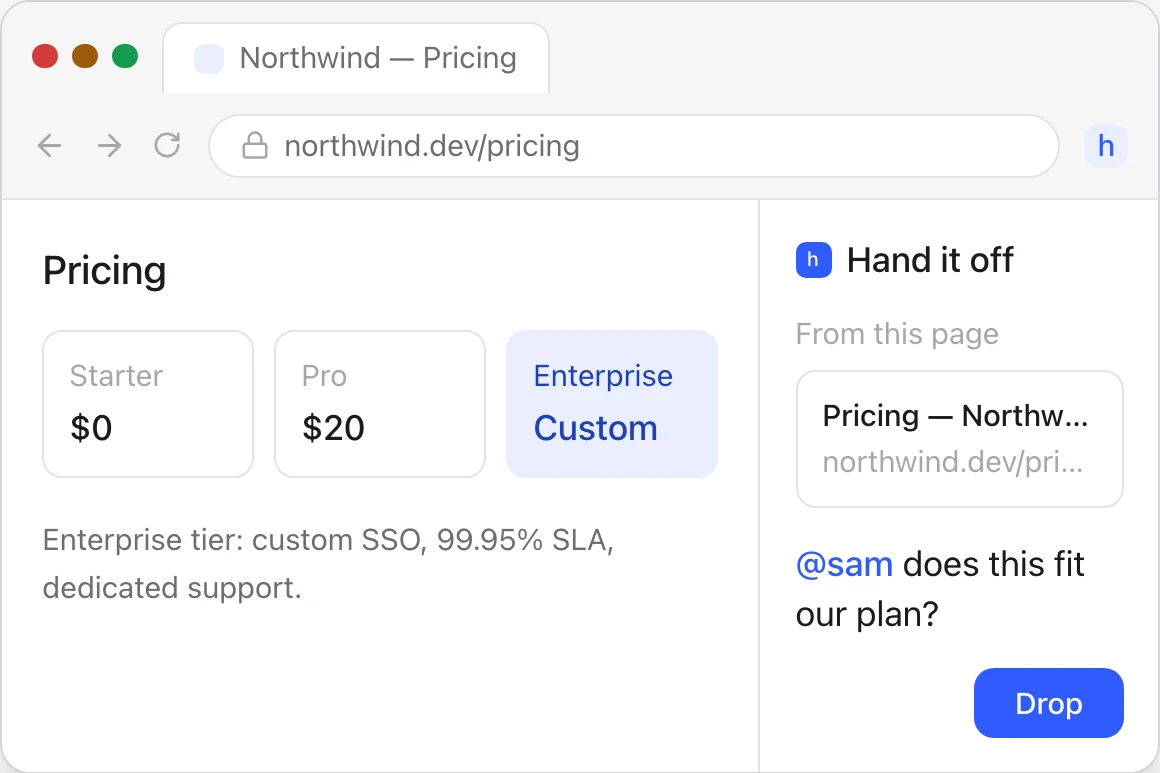
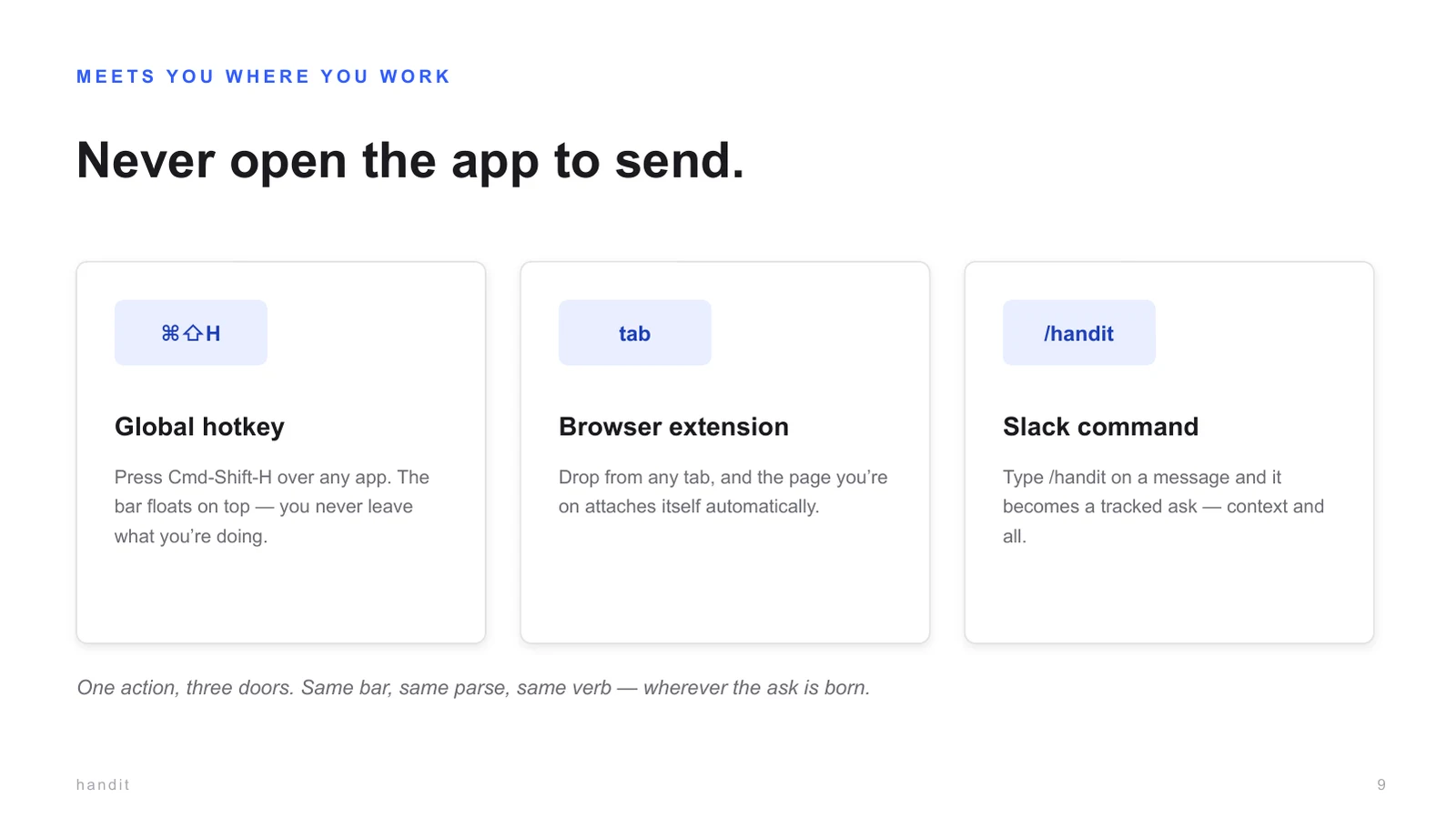
Most asks are born in Slack, Teams, email, or a browser tab. So you can drop one from any of them without opening Handit.
-
Sell to teams, not individuals.
An ask needs someone on the other end, so Handit is sold by the seat and set up for the whole team on day one. Anyone can ask. Only the people who handle asks need a seat.
where it sits
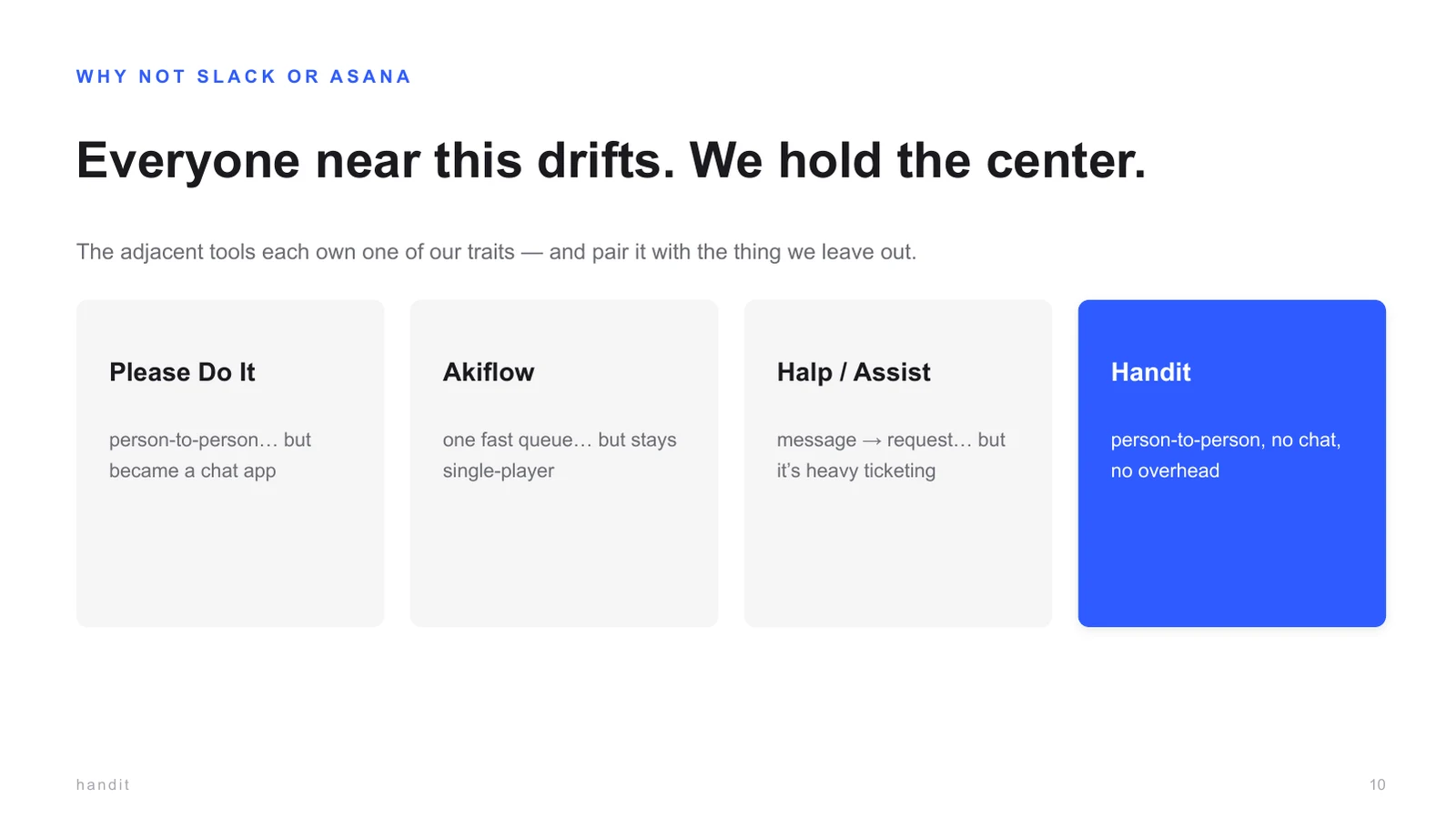
Every tool near this space owns one of Handit’s traits, then pairs it with the thing Handit leaves out. One went person-to-person but turned into chat. One is fast but single-player. One turns messages into requests but becomes a ticketing system.
Handit holds the center: person to person, no chat, no overhead.
how it reaches people
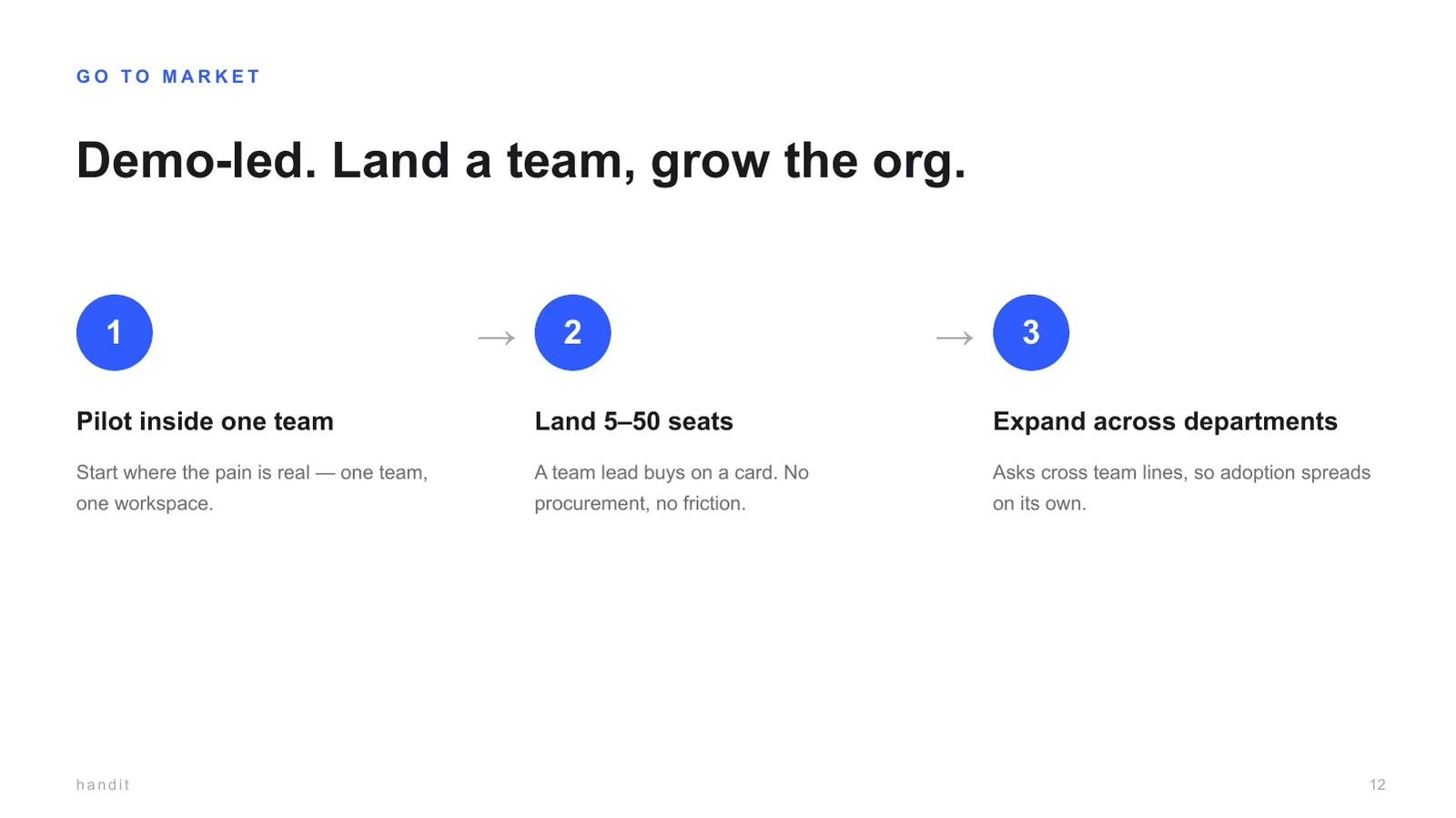
- Pilot inside one team.Start where the pain is real: one team, one workspace.
- Land 5 to 50 seats.A team lead can buy it on a card. No procurement.
- Spread across departments.Asks cross team lines, so adoption travels with them.
the words
Handit is mostly language: a handful of plain words, used the same way everywhere.
the name
hand it → hand it off.
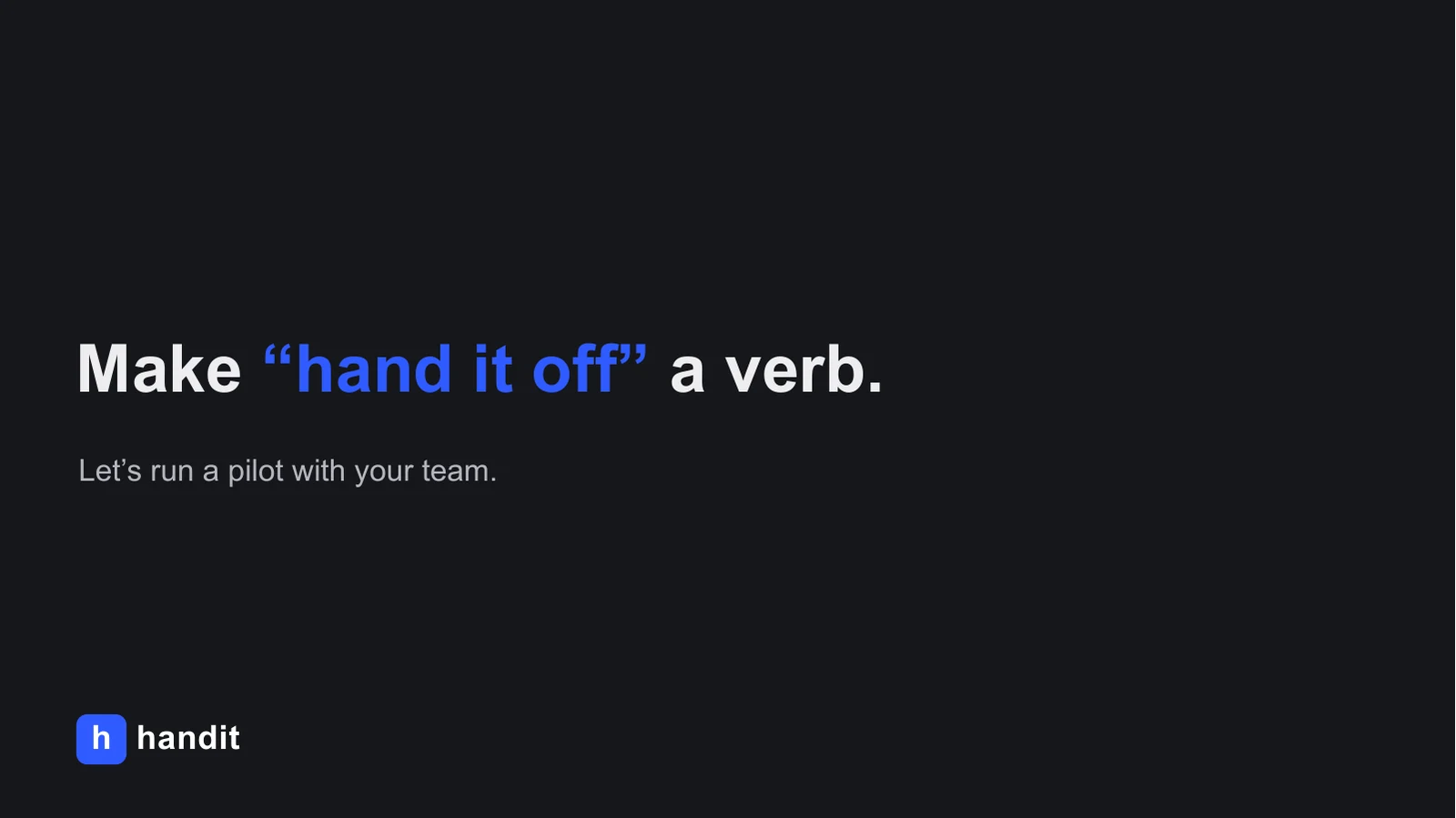
Handit is a verb you can already say: hand it. The brand line finishes the thought: hand it off. The pitch deck ends on it, the site’s last section says it, and the footer signs off with it.
five words, used everywhere
I gave every part of the product one short word, and used that same word in the code, the app, the website, and the pitch.
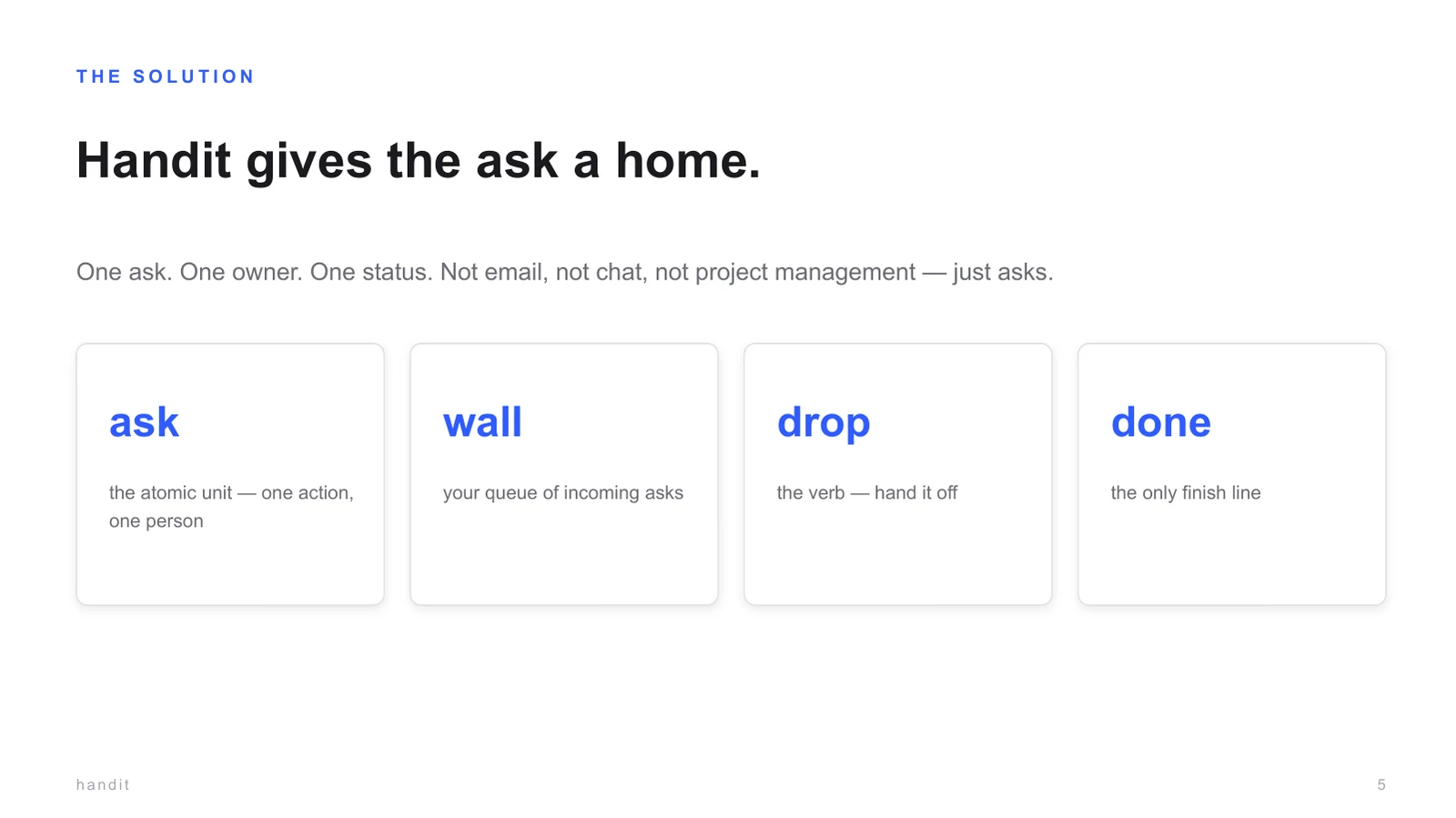
- ask
- the unit of work: one action, one person
- wall
- your queue of incoming asks
- drop
- the verb: hand it off
- accept
- the handshake that makes it yours
- done
- the only finish line
the headline, three tries
- May · pitch deck
Hand work off. Watch it get done. - June · sales copy
Stop losing requests everywhere. - now · handit.toEvery ask gets an owner.
The first described the action. The second named the pain. The one on the site makes a promise in five words, and it doubles as the product’s one rule.
words that close, not chat
- The note field says
Add a note…
, not “Message.” Notes are capped at ten. It never becomes a chat. - The list of asks you’ve sent is labeled
what your coworkers owe you.
- When an ask lands on the wrong person:
Wrong person? Hand it on, not back.
And the rule behind it:One ask, one owner, never a chain.
- Pricing in one line:
Everyone can ask. Only handlers need a seat.
- Sentence case everywhere. No Title Case, no ALL CAPS.
the manifesto
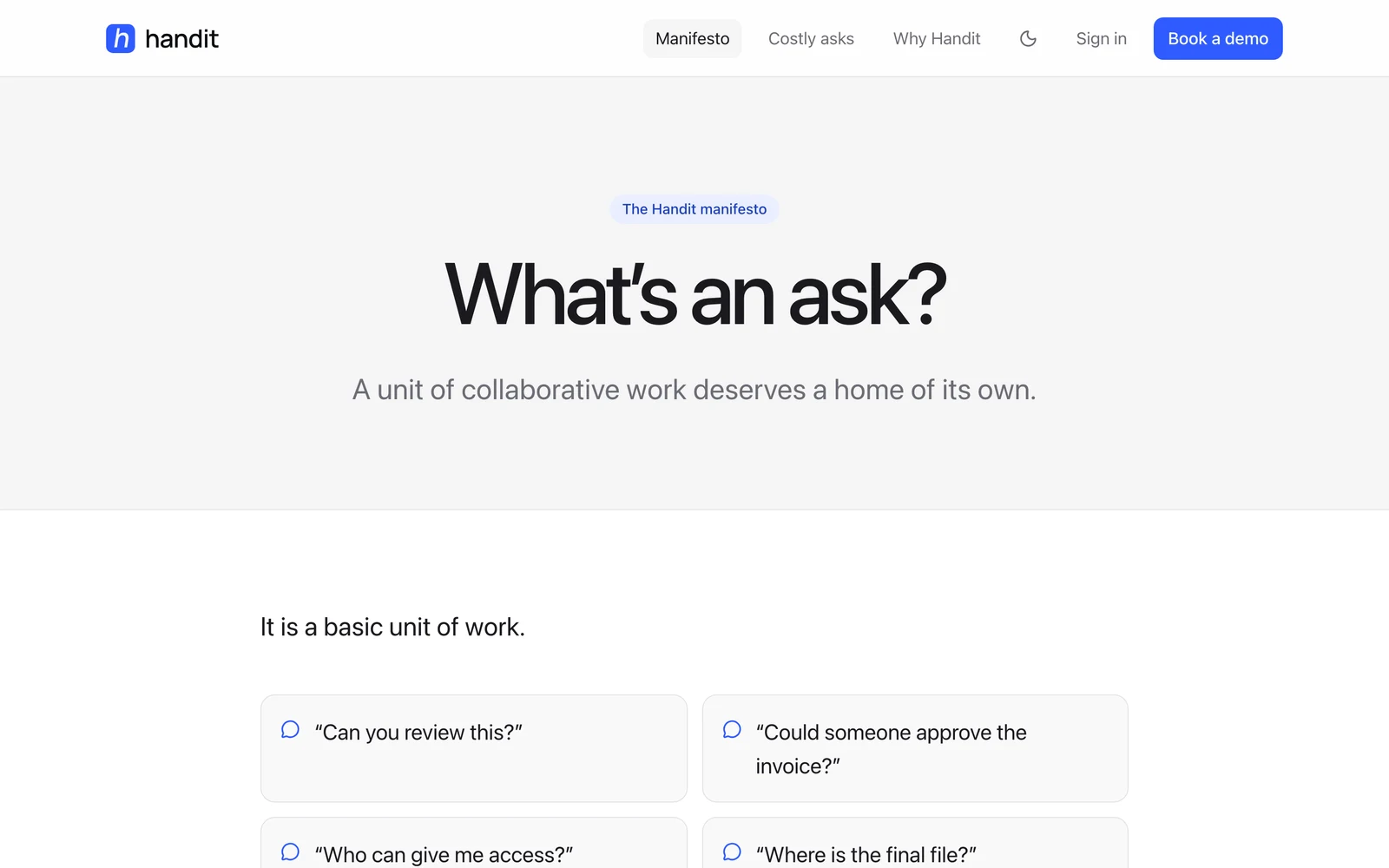
“This is how a five-minute request becomes three days of coordination.”
“We were promised productivity. Instead, many people spend most of the day administering productivity.”
I wrote a manifesto for the long version of the why, and signed it as the founder.
the costly ask library
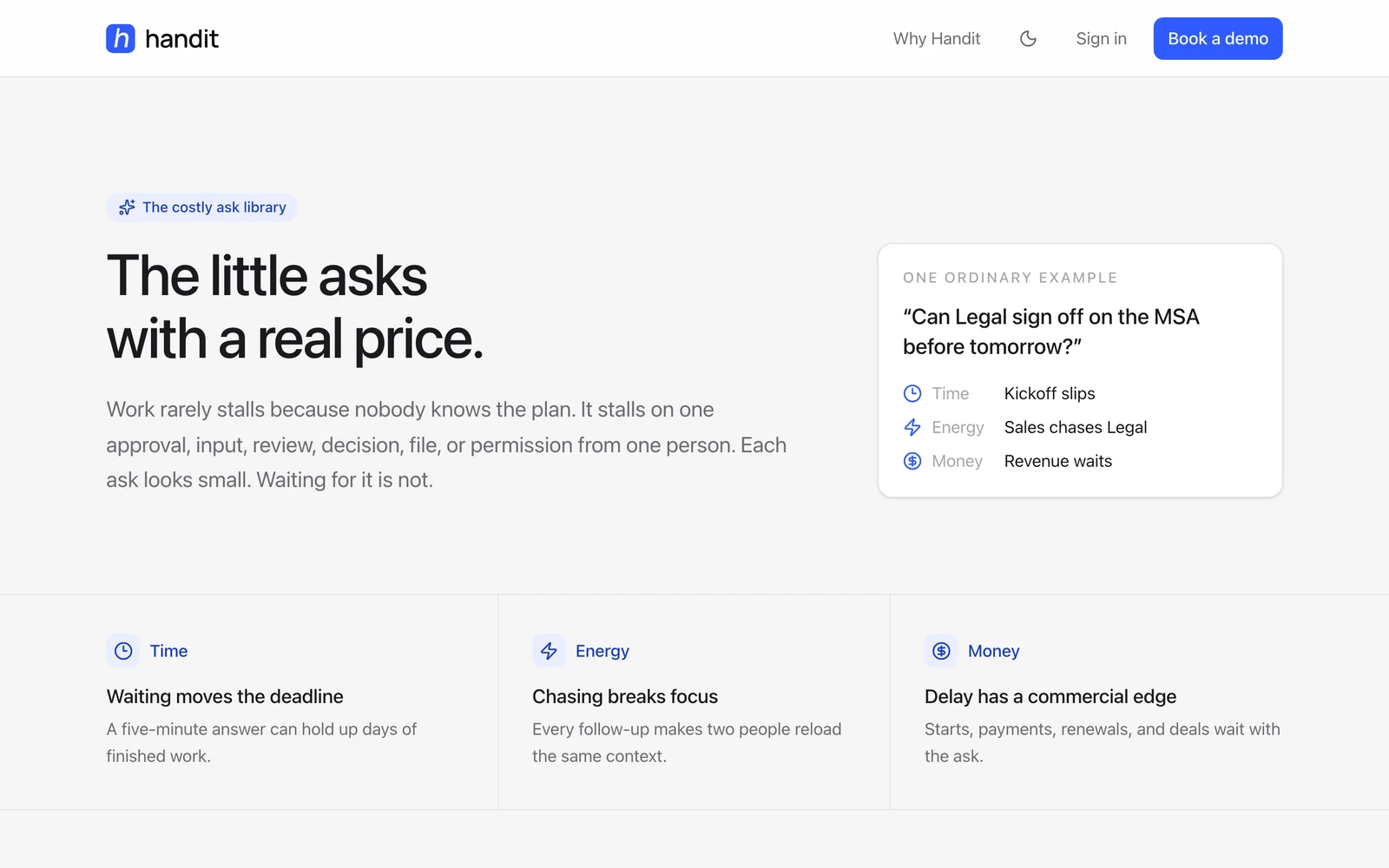
A library of 18 everyday asks, sorted by category. “Can Legal sign off on the Meridian MSA before tomorrow?” “Can IT give the new account manager access to Salesforce today?”
Each one shows what the wait costs in time, energy, and money, and how Handit closes it.
the design
Calm, fast, and almost empty on purpose.
the mark



A lowercase h, leaning forward, into the handoff.
It’s written, not drawn. The h in the icon and the h in the wordmark are the same letter, set in Manrope, all lowercase.
one color
One accent, one blue. Everything else is ink and paper. Green, amber, and red only ever mean a status.
- blue
#2F5BFF - ink
#0D0E12 - paper
#F6F7F9 - done
#159A50 - needs info
#9A5B0B - blocked
#D23B3B
the feel is the feature
The interface never waits on the network. Every tap lands instantly. There are no spinners and no “are you sure?” dialogs. You get five seconds to undo instead.
My test was a stopwatch: dropping an ask had to be faster than sending a Slack message.
Try the handshake:
Turn around the contracting officer’s feedback before Friday.
A web version of the card, built from Handit’s own rules.
quiet by design
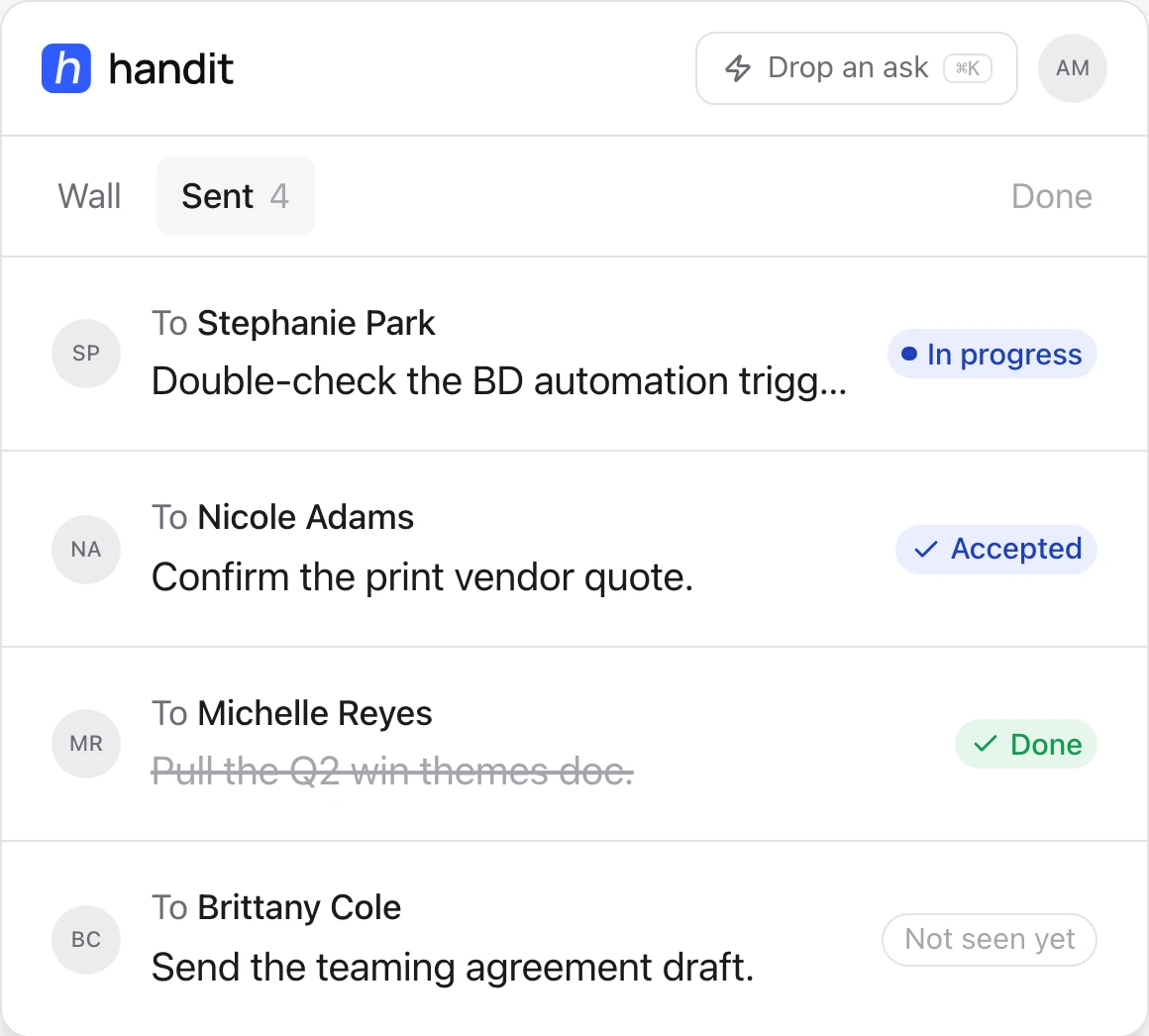
In the list of asks you’ve sent, an ask nobody has seen yet gets the quietest label, a thin outline, not the loudest.
Handit shows where things stand without nagging anyone. There are no “any update?” pings to send, because there’s nothing you need to ask.
the screens
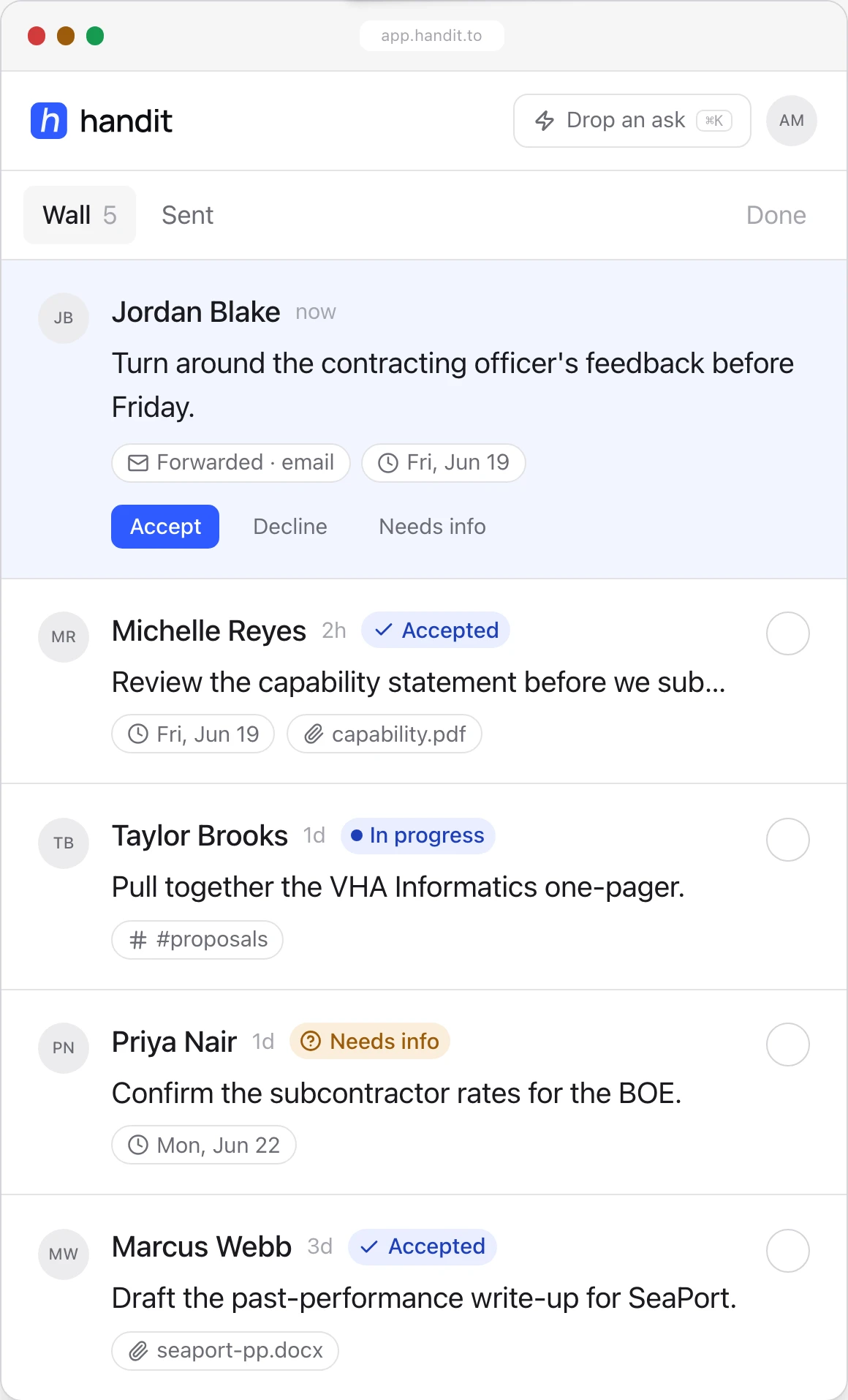
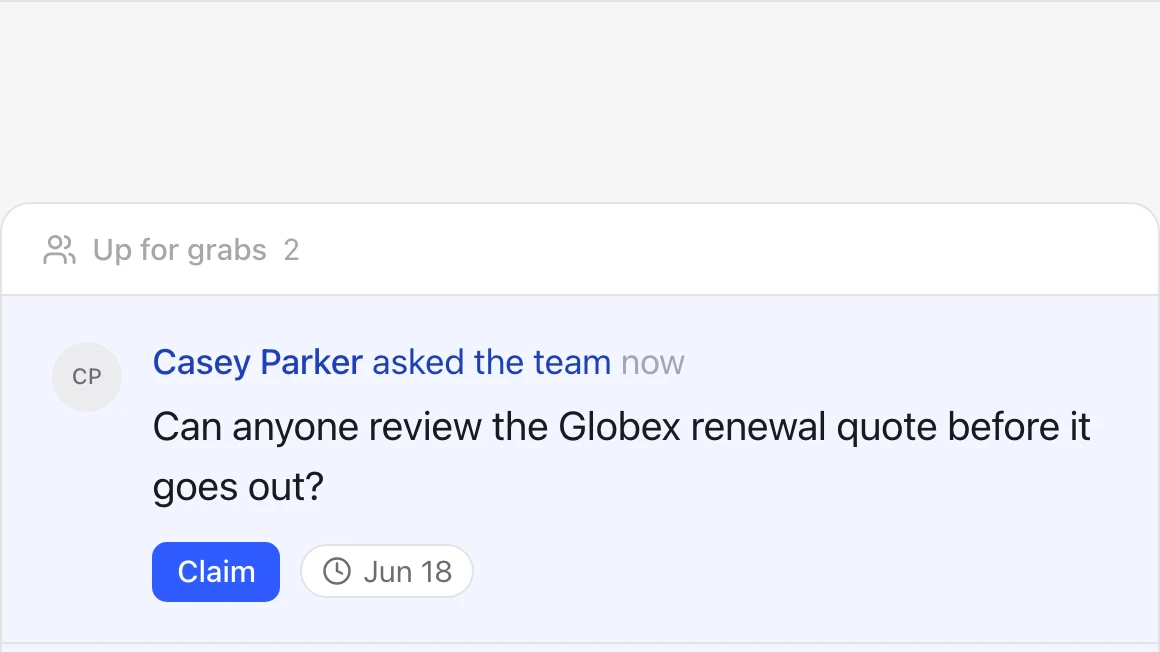
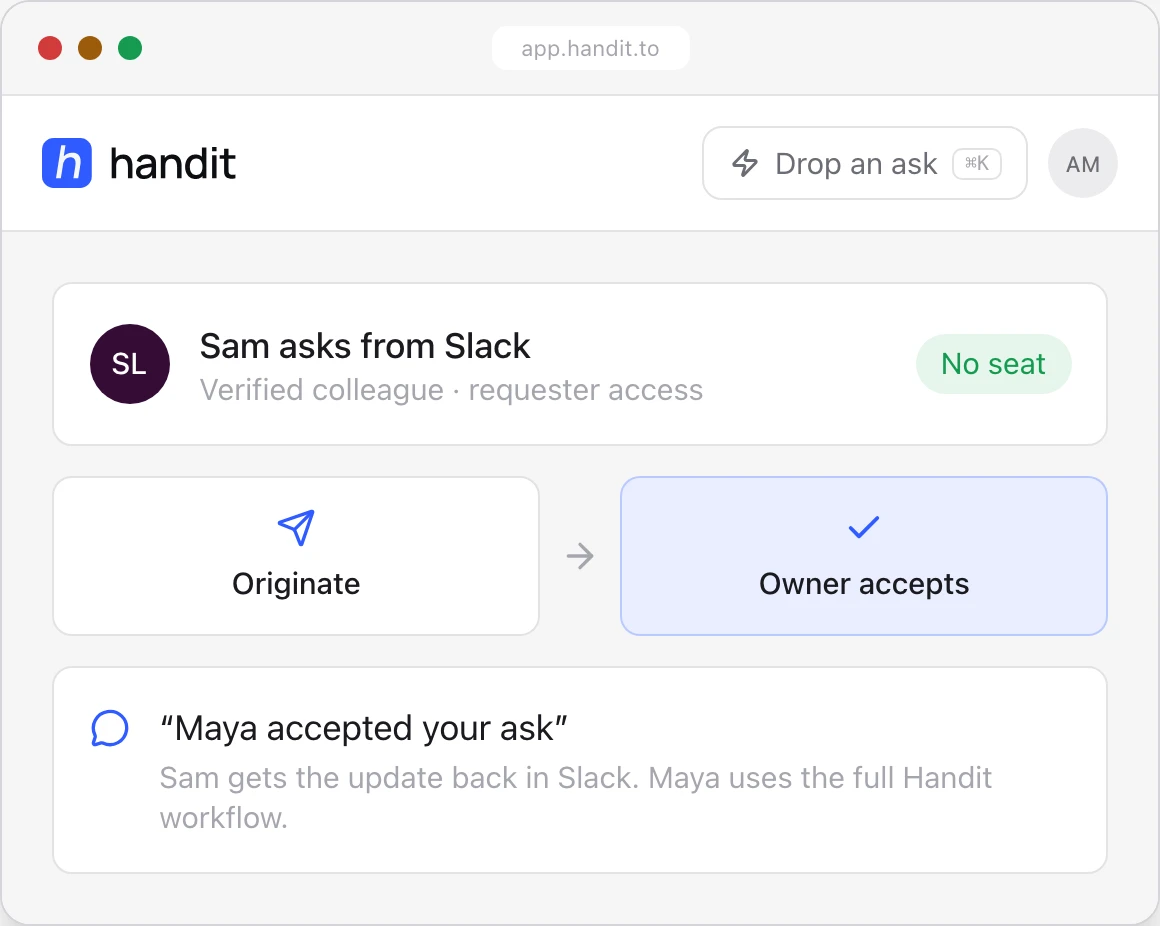
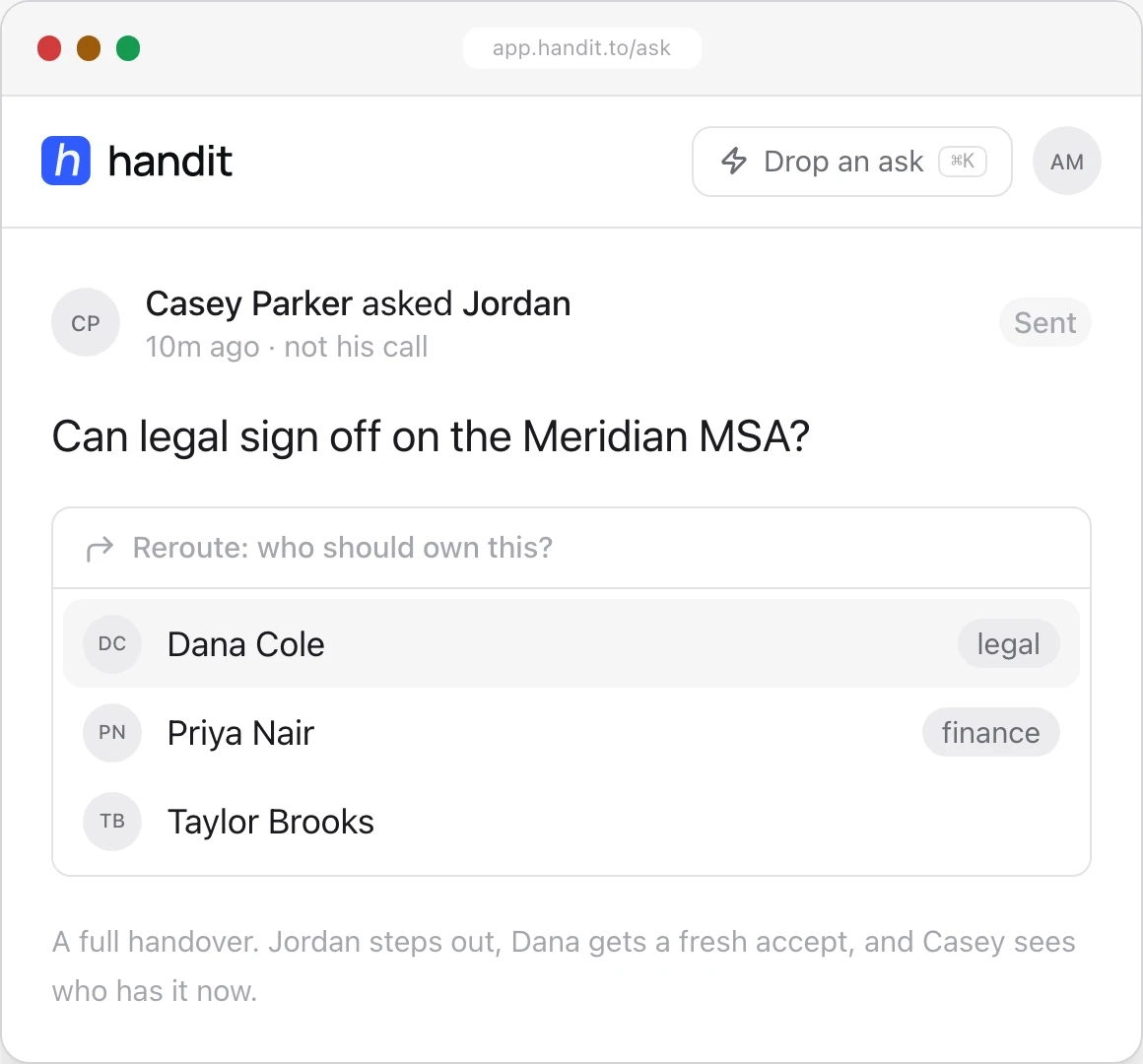
capture, wherever the ask is born
the website
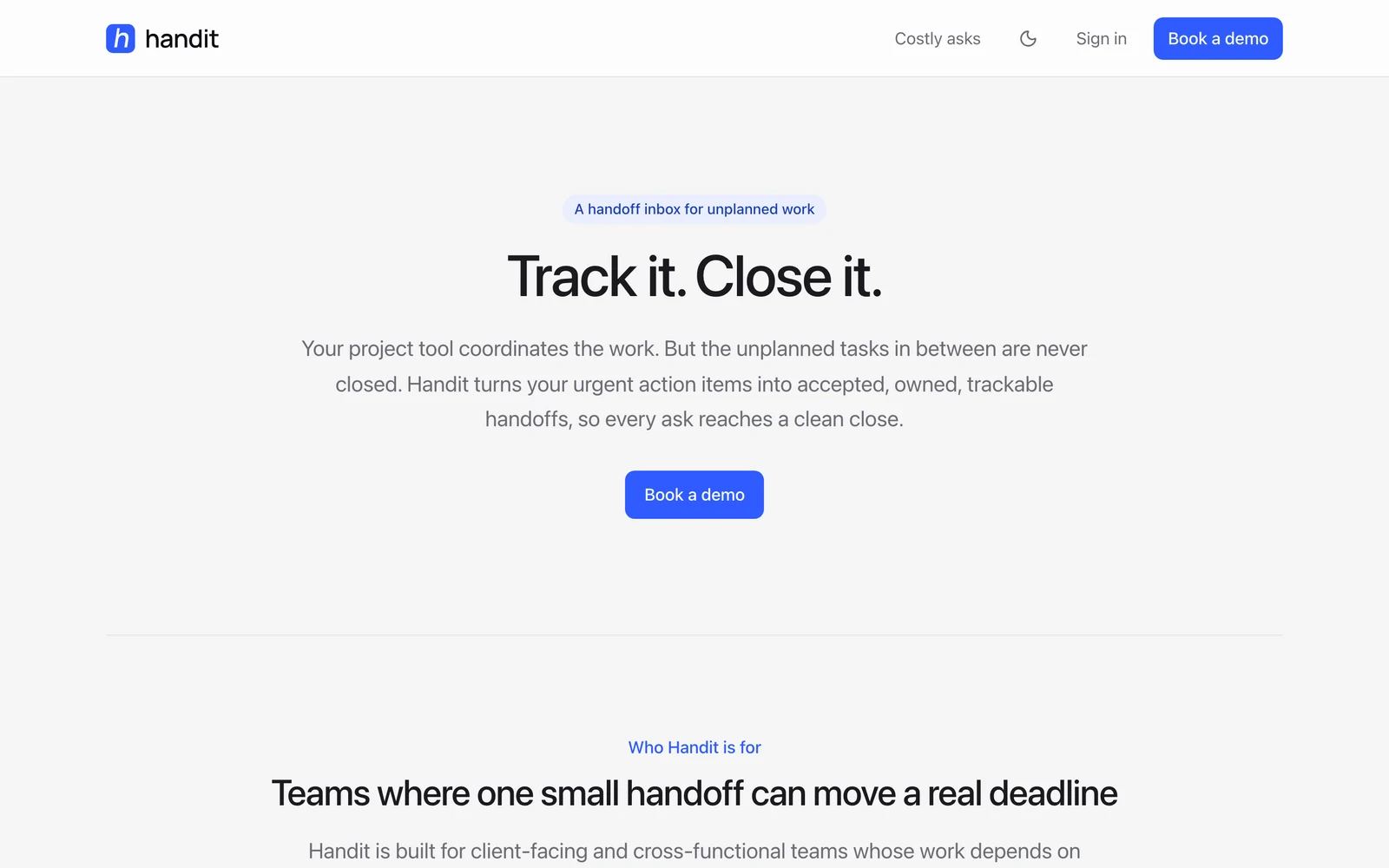
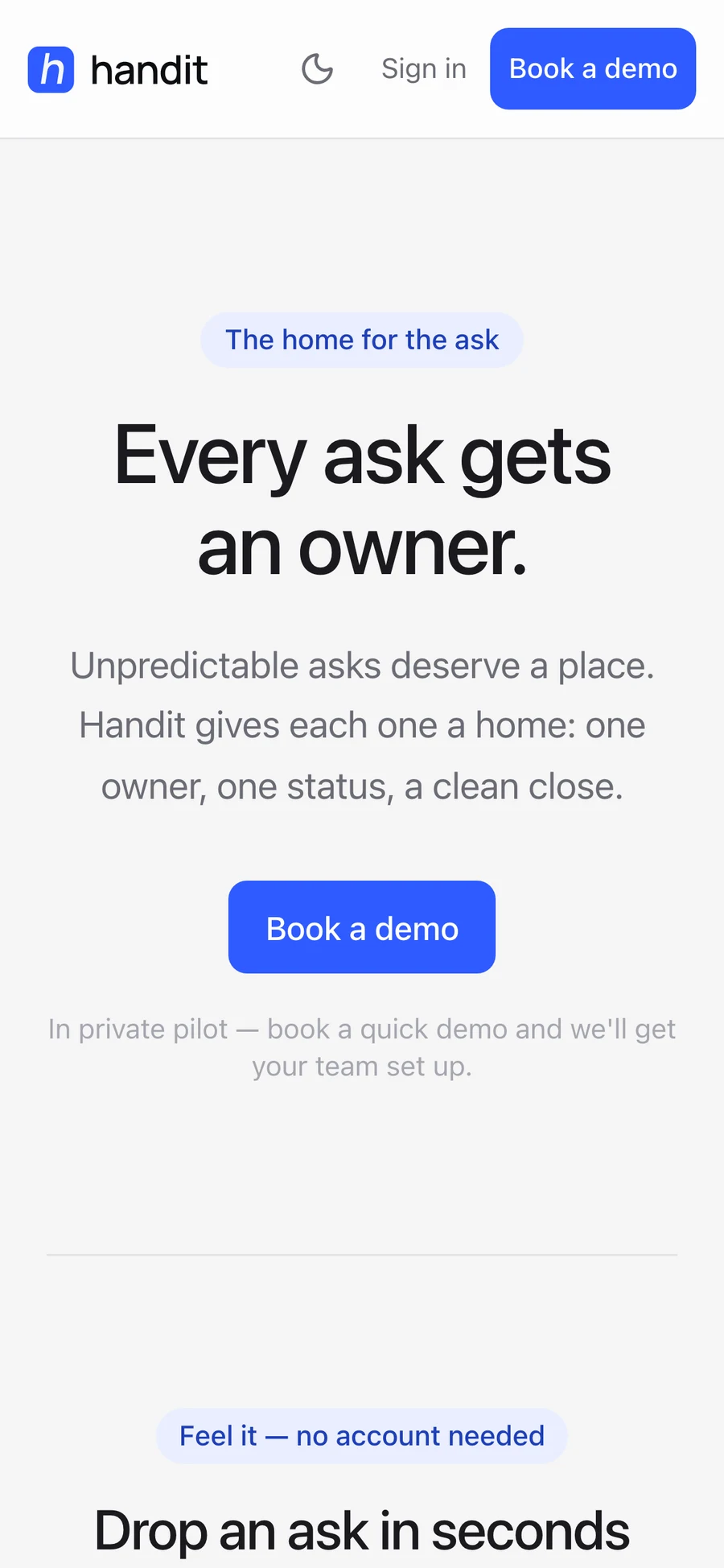
The homepage lets you try the product without an account. “Why Handit” answers the buyer’s question: Track it. Close it.
the pitch deck
Thirteen slides, one idea each, in the same restrained style as the product.
built, too
I wrote the build spec before any code existed.
It set the rules first: the vocabulary, the seven statuses, a list of features Handit must refuse, and the stopwatch test.
Then I built the web app to match, so every change shows up instantly, and added capture from Slack, Microsoft Teams, forwarded email, and a browser extension.
Handit is in private pilot. The offer is simple: bring one real handoff, and watch it close.
next
Proposal Hall