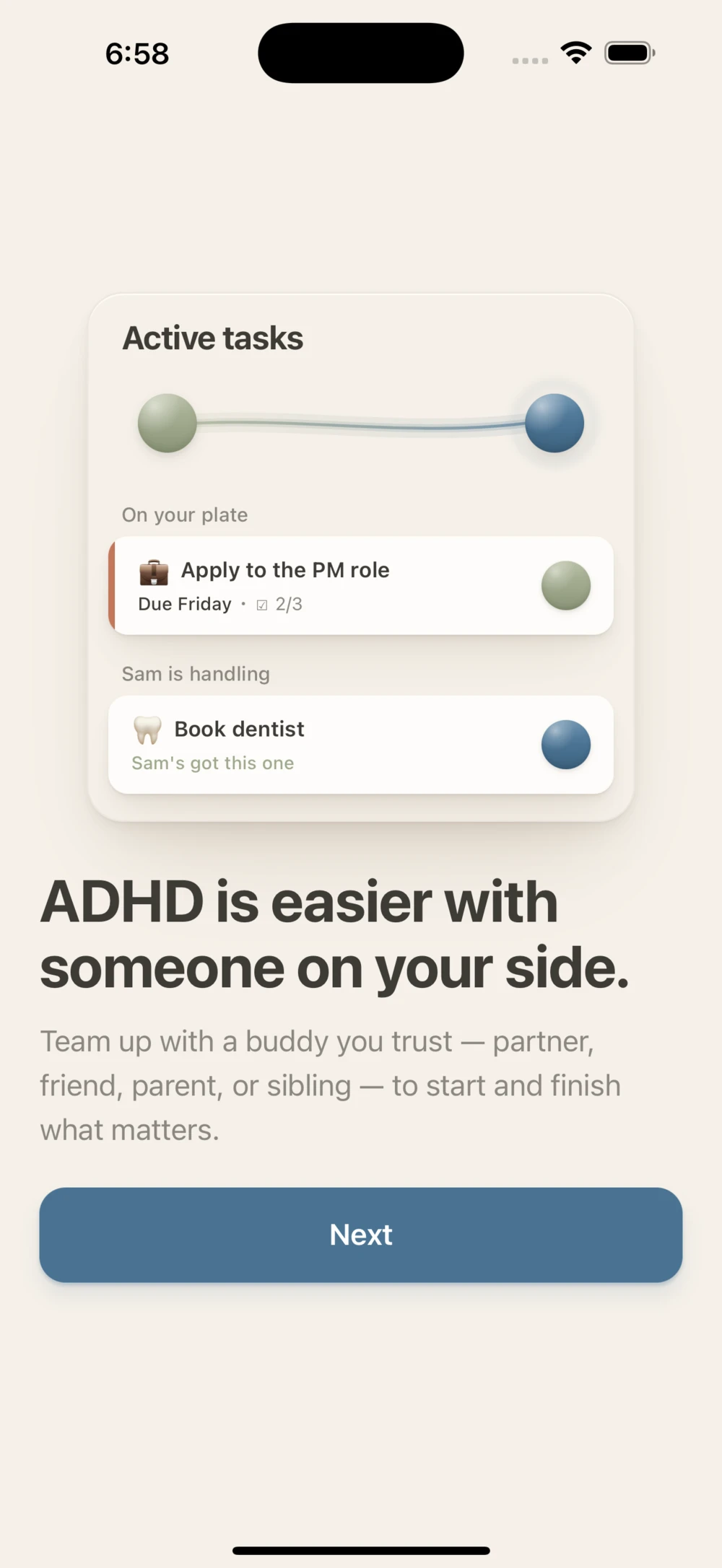
ADHD is easier with someone on your side.
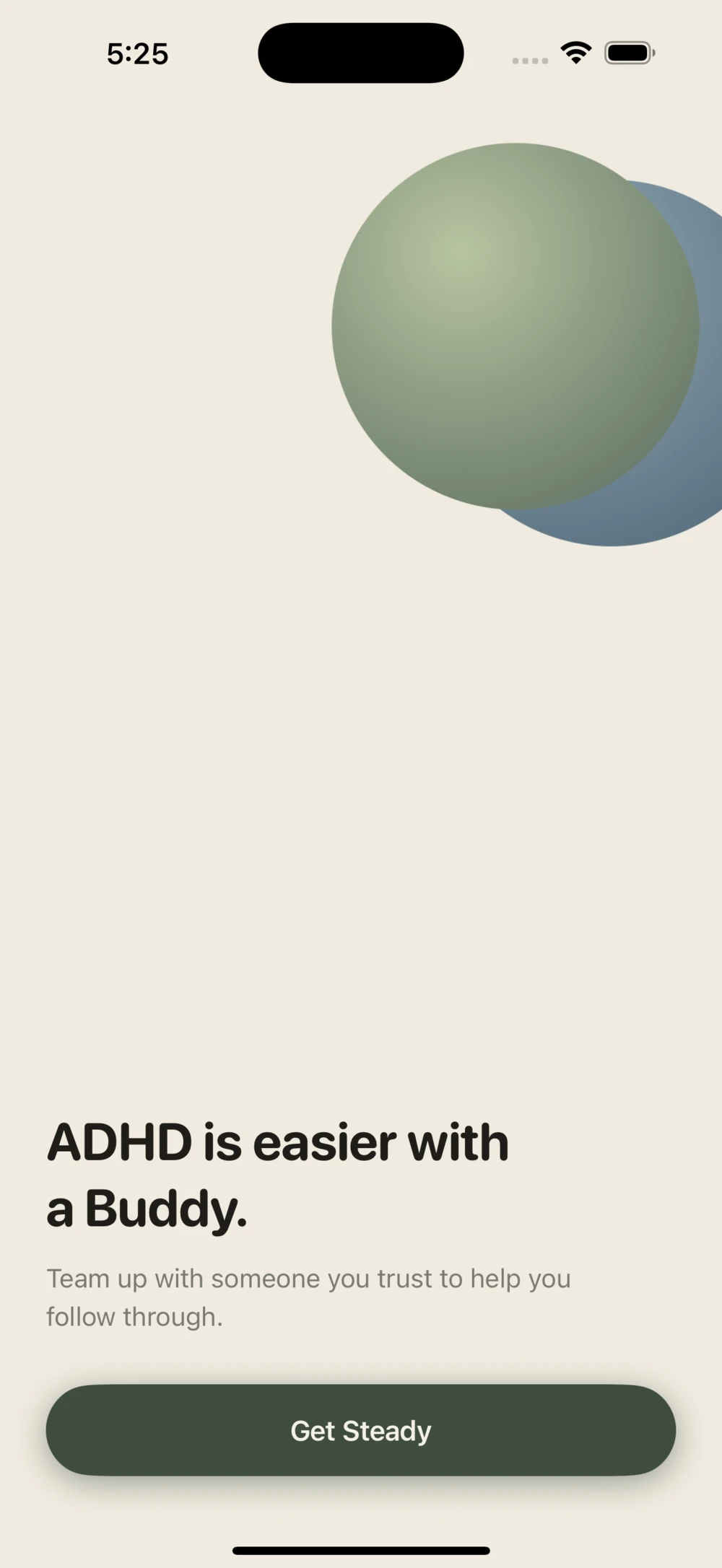
ADHD is easier with a Buddy.
Shorter, and it introduces the one word the whole app runs on.
An iPhone app for people with ADHD, and for the one person who has their back. They share a list, so getting things done doesn’t depend on willpower alone.
If you have ADHD, knowing what to do is rarely the hard part. Starting it, and finishing it, is.
One thing that helps is having another person nearby while you work. It’s called body doubling. But nobody can sit next to you all day.
Steady stretches that help across the whole day. Two people pair up. The Explorer keeps the list. The Anchor is a partner, roommate, parent, sibling, or friend who has their back.
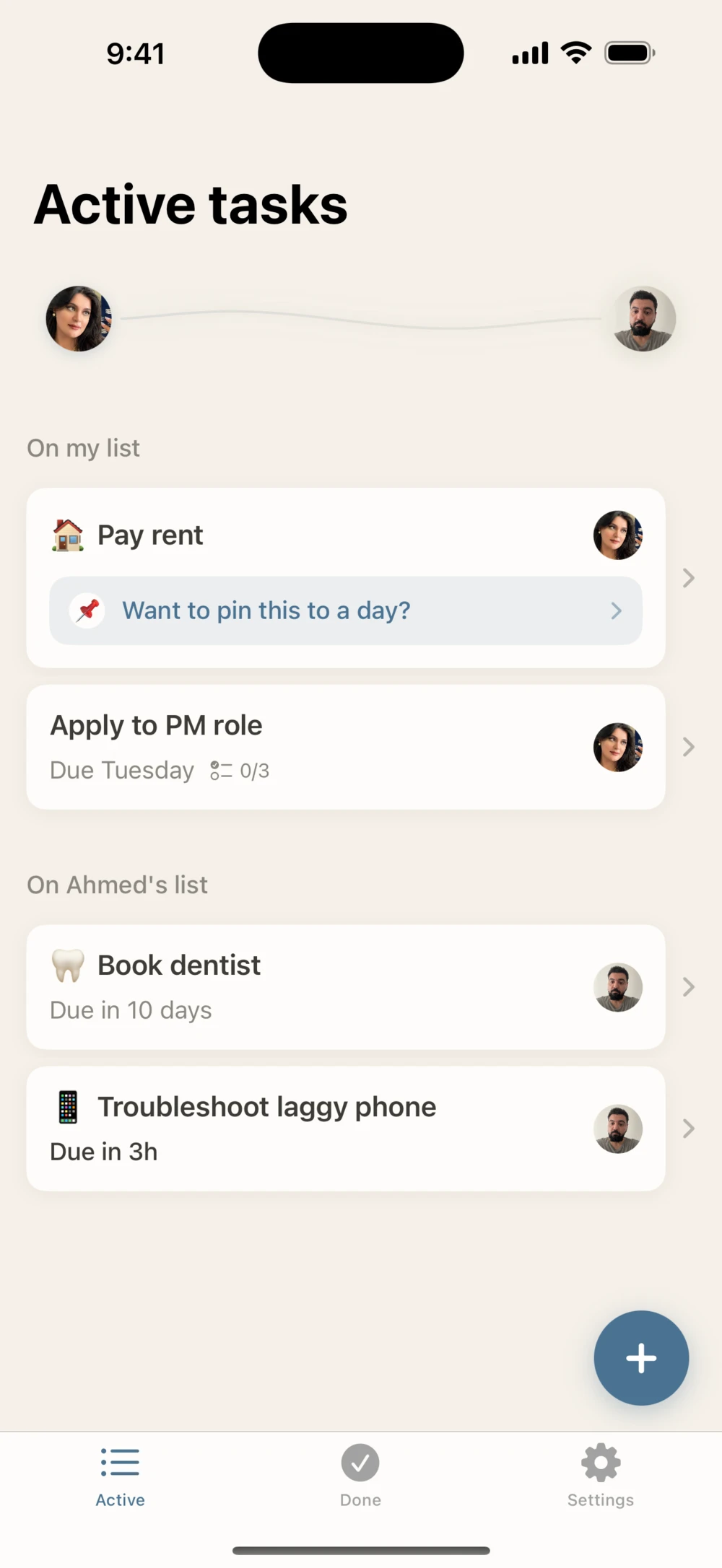
The Anchor can see the list, add to it, send a nudge when something stalls, and take a task off the Explorer’s plate when the day gets too full.
That’s the whole app. No streaks, no points, no scoreboards.
Most to-do apps assume you can manage yourself. Steady starts from the opposite idea: you shouldn’t have to do it alone.
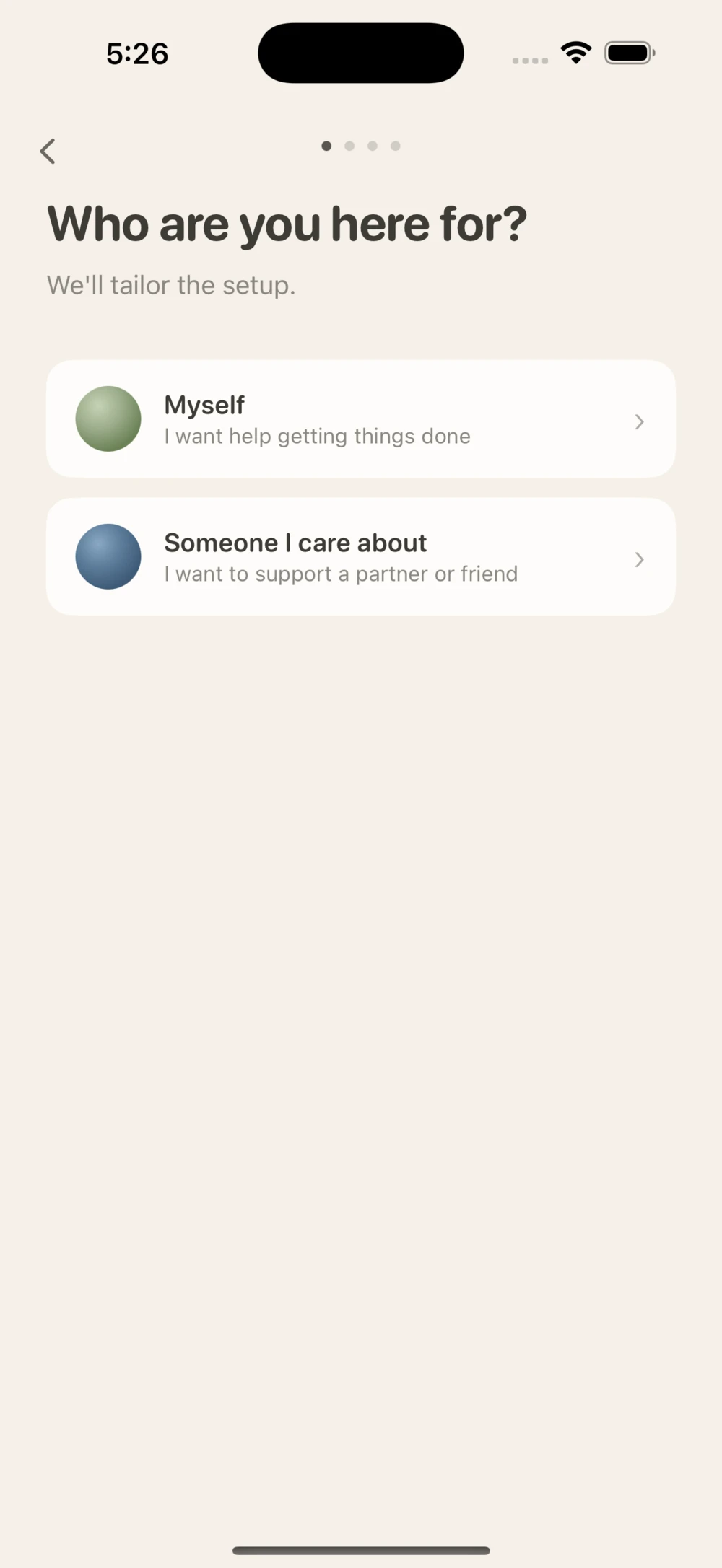
The Anchor isn’t a guest in someone else’s app. From the first screen, each person picks a side, “Myself” or “Someone I care about,” and gets their own setup, their own words, and their own buttons.
The Anchor can help, but can’t take over. Each person sees only the actions that fit their role, and the app enforces that line behind the scenes, not just on screen.
No streaks, no badges, no red alarms. When something slips, the app asks a question. It never scolds.
Nudge Tandem Steady
The app was called Nudge, then Tandem, before it shipped as Steady. The first two names described how the app works. Steady describes how it should feel. It also gave the pair a line for the moment they connect: You and Sam are now steady.
In an app people open every day, the words do most of the emotional work. I wrote all of them: the onboarding, every button, and 31 different notifications and prompts.
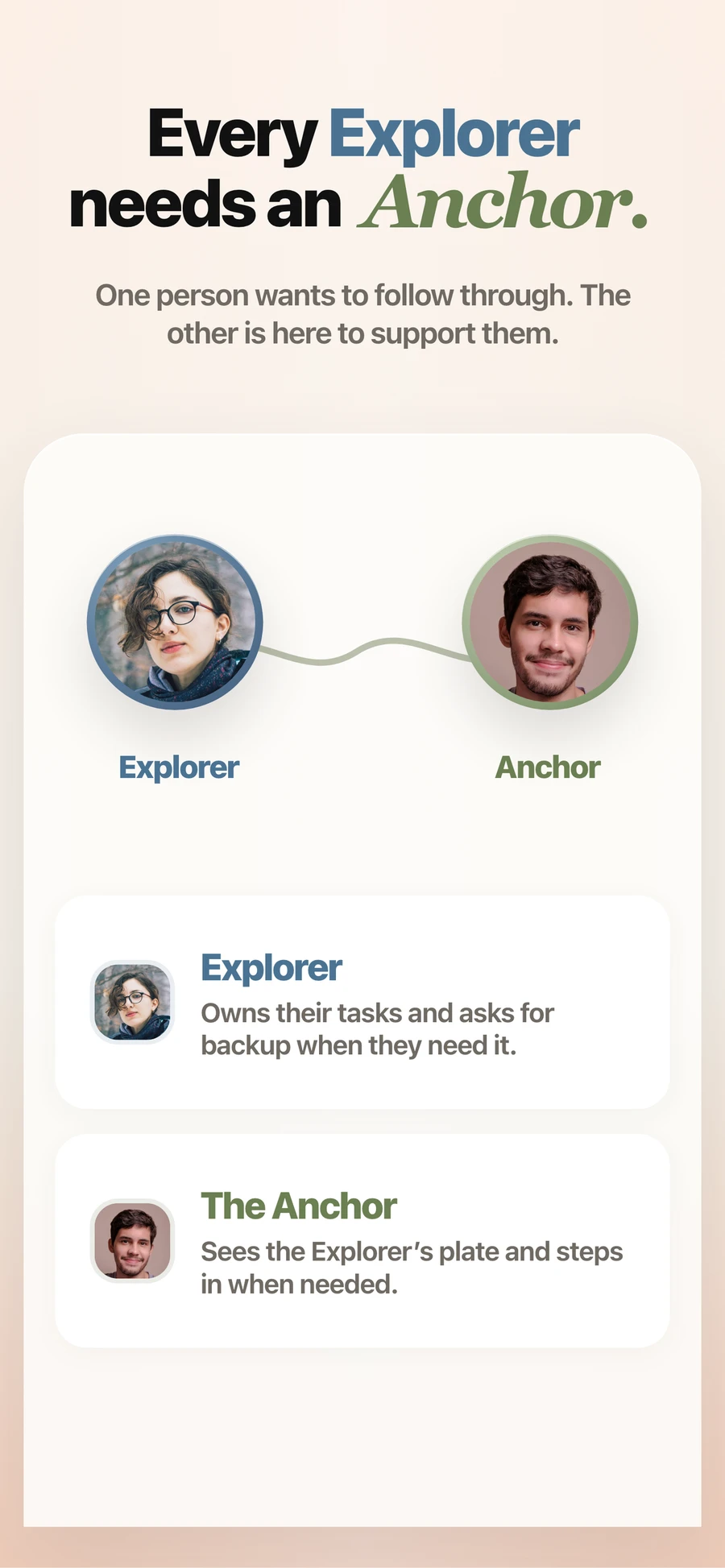
Steady works with two. Each plays a different part.
Partners · roommates · parent & child · siblings · friends — anyone who could use a hand.
The one with the list.
I’m here to get things done. I can add tasks, mark progress, and ask my Anchor to take something on when I’m stuck or maxed out.
My role is to stay in charge of what matters, with support close by.
The one in their corner.
I’m here to support someone I care about without taking over. I can see what’s on their plate, add to it alongside them, send gentle nudges, and take something on when they ask — or when I sense they could use a hand.
My role is to be a calm, practical presence.
Each role speaks in its own voice, so the app reads as a pair rather than an owner and a helper.
“I spent a disproportionate amount of time on the names, because words do quiet work inside a tool people live in, and I wanted nobody using Steady to feel like a boss or a project.”
From my essay on why I built Steady
In everyday copy, the other person is your buddy. “Partner” can sound like business or romance, and an Anchor might be a sibling, a friend, or a parent.
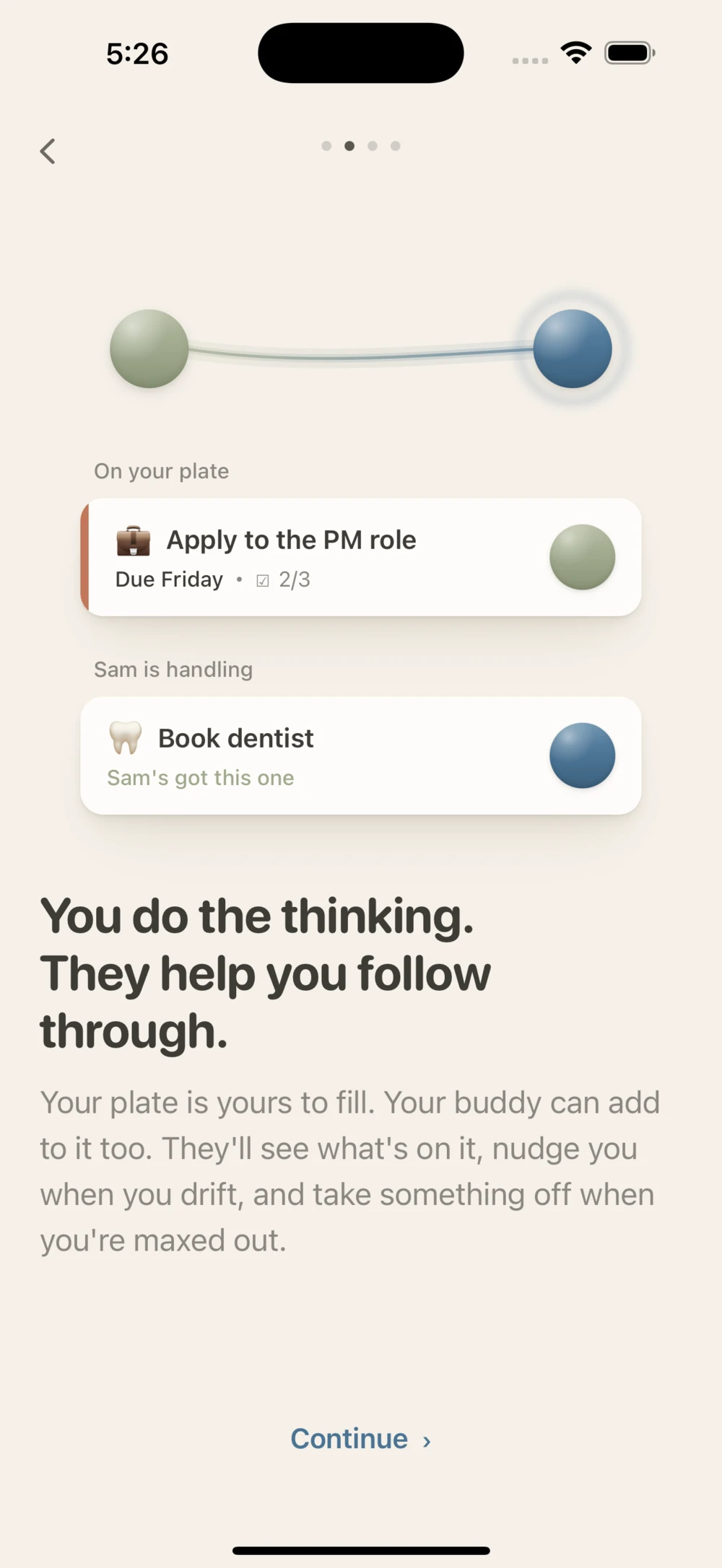
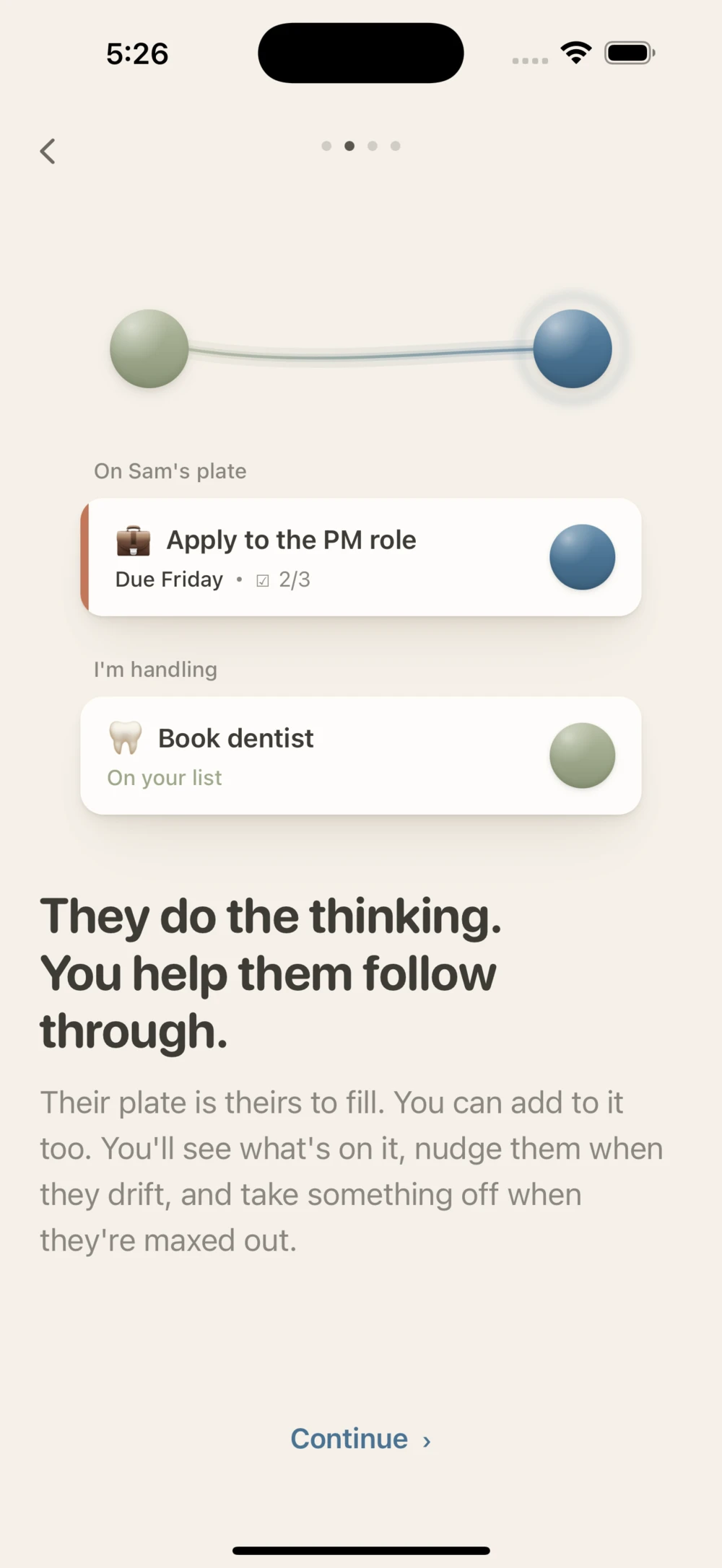
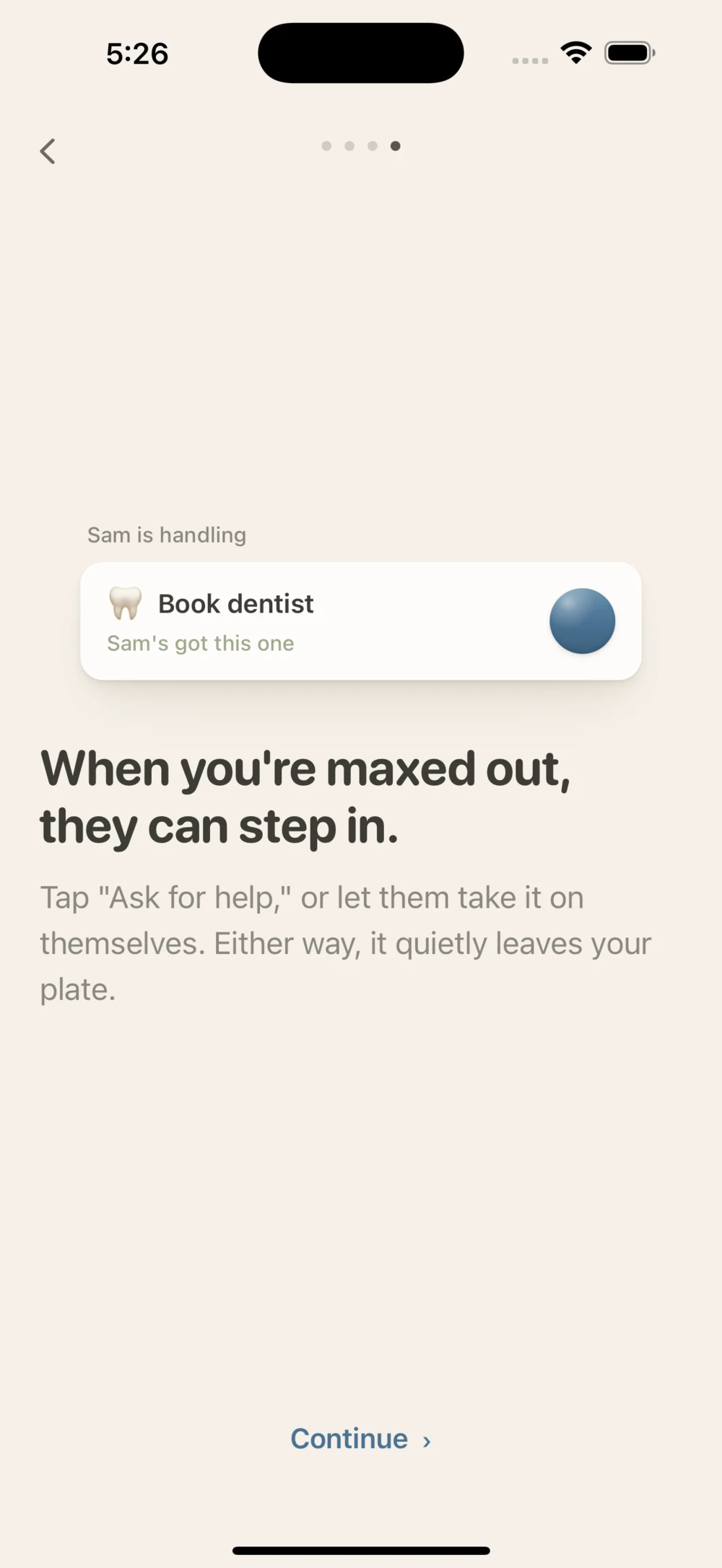
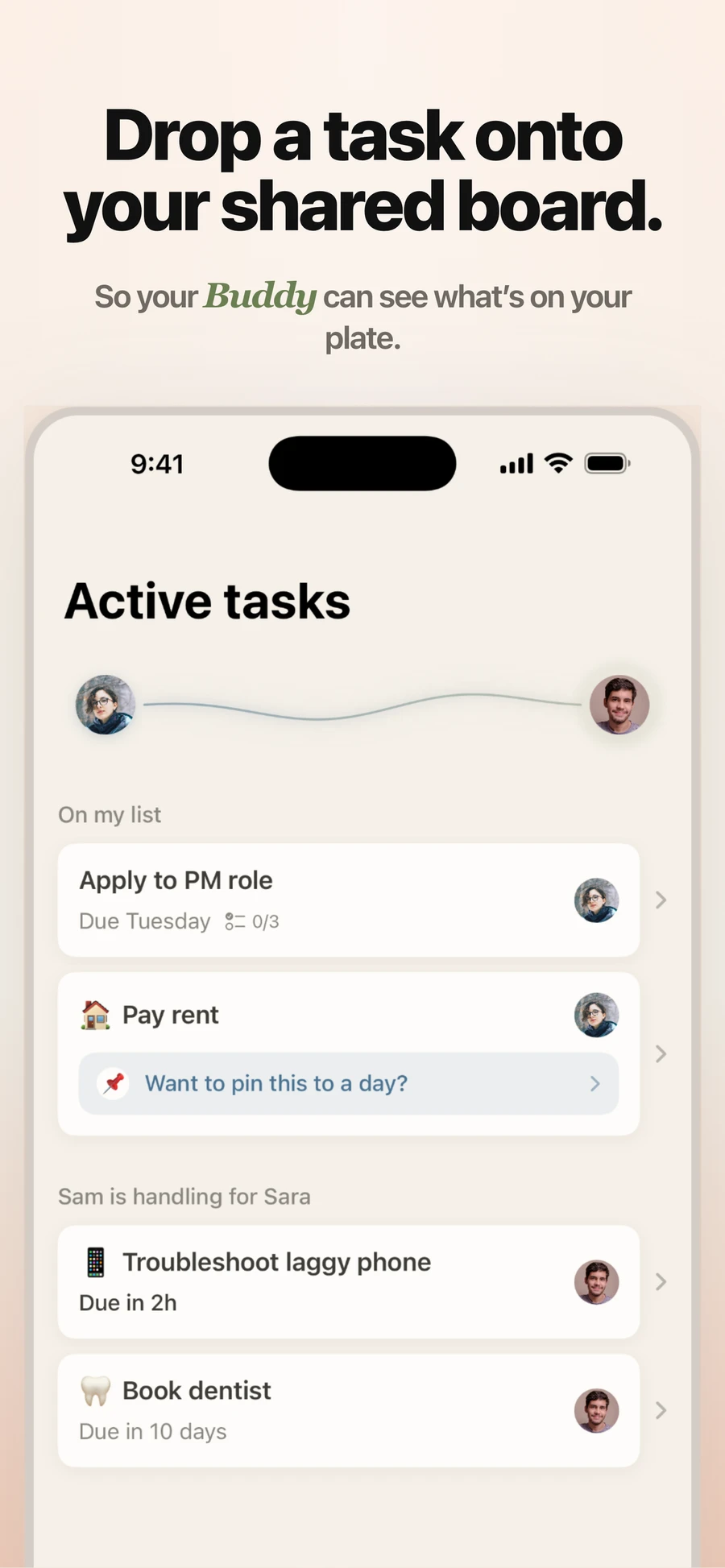
Tasks sit on someone’s plate. When help arrives, the task moves: “Sam’s got this one.” “I’m handling.” Handing something off feels physical. It leaves your plate.
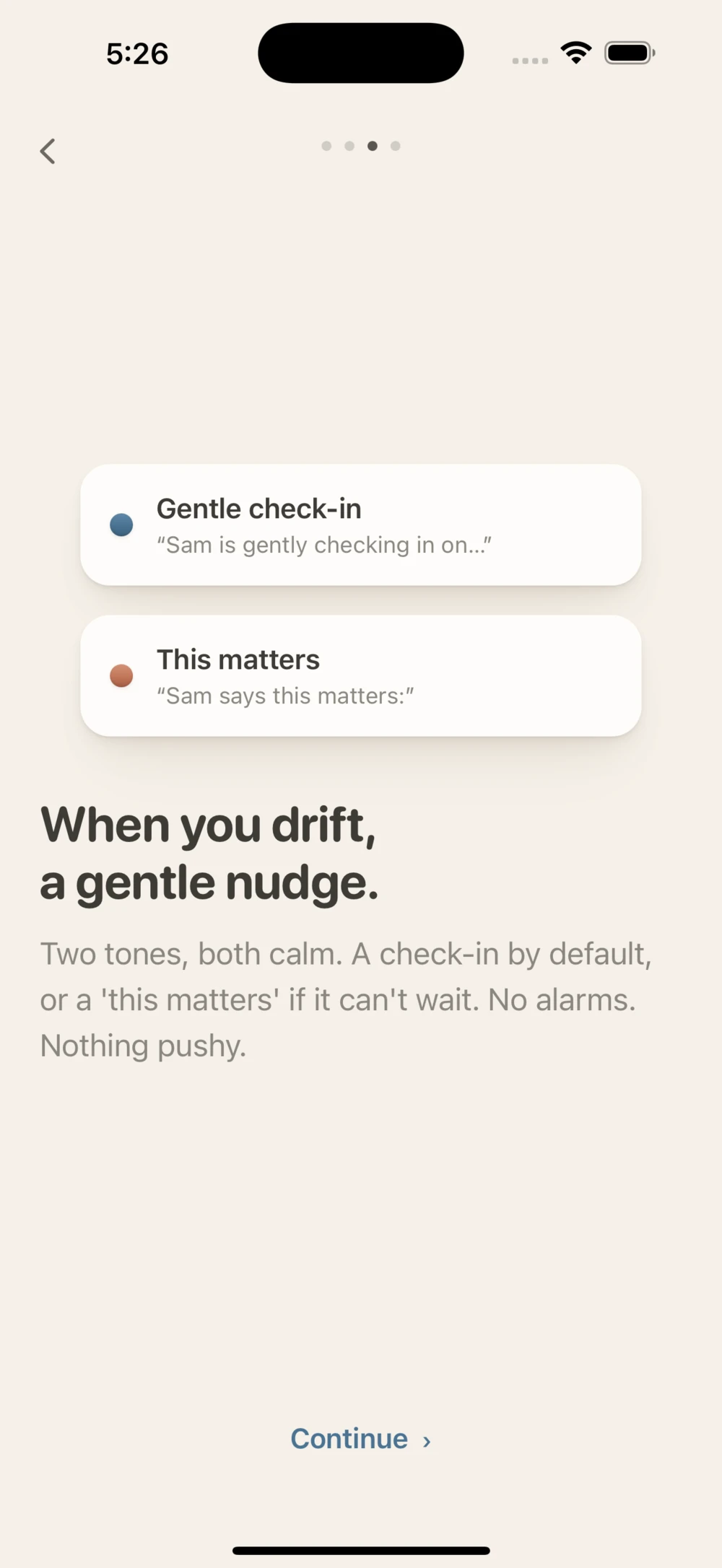
A nudge is how the Anchor says “remember this?” without nagging. Before sending one, the Anchor answers a single question: How should this feel?
The Explorer can answer right from the lock screen, in one tap:

Steady has 31 different notifications and prompts. They follow four rules.
The title is the task. The body says what happened. The first version said everything twice.
If the Explorer doesn’t answer a nudge, the follow-ups state facts: after 30 minutes, “Sam checked on this item,” and after an hour, “Sam checked again.” An earlier version said “Sam is still waiting.” That made a reminder sound like a complaint.
“Nudge” only ever means the nudge button. When an Anchor added a task, the app used to say, “We’ll send them a gentle nudge.” That muddled two different things, so now it says, “We’ll notify them.”
After two quiet days, each person gets a different note. The Explorer’s is about help. The Anchor’s is about showing up.
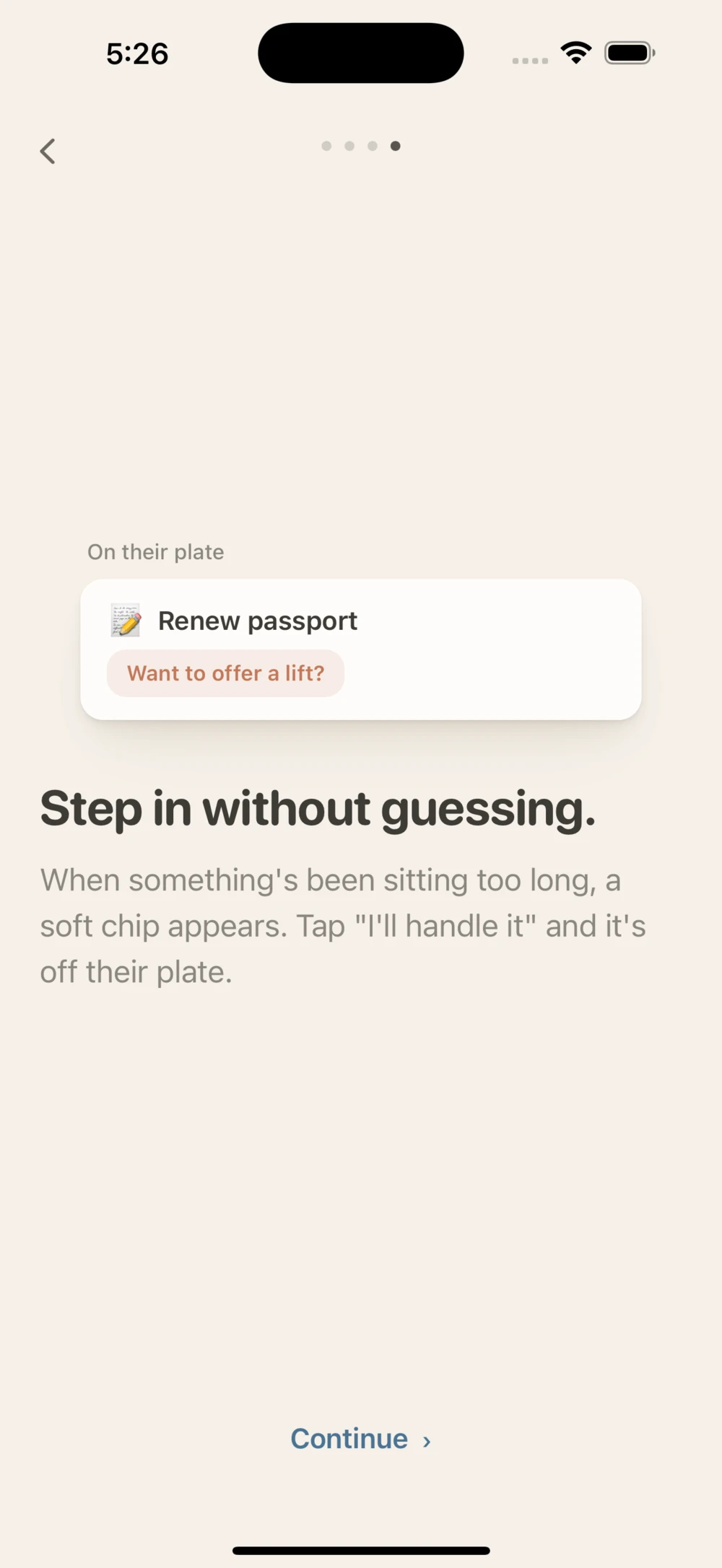
When a task sits untouched for too long, a small chip appears on its card. It’s always a question, and it gets firmer slowly.
day 3Want to pin this to a day?
day 10Pin a time — or clear it off?
day 5Want to check in on this?
day 14Want to offer a lift?
The onboarding went through several rounds. Three edits show how I work.
ADHD is easier with someone on your side.
ADHD is easier with a Buddy.
Shorter, and it introduces the one word the whole app runs on.
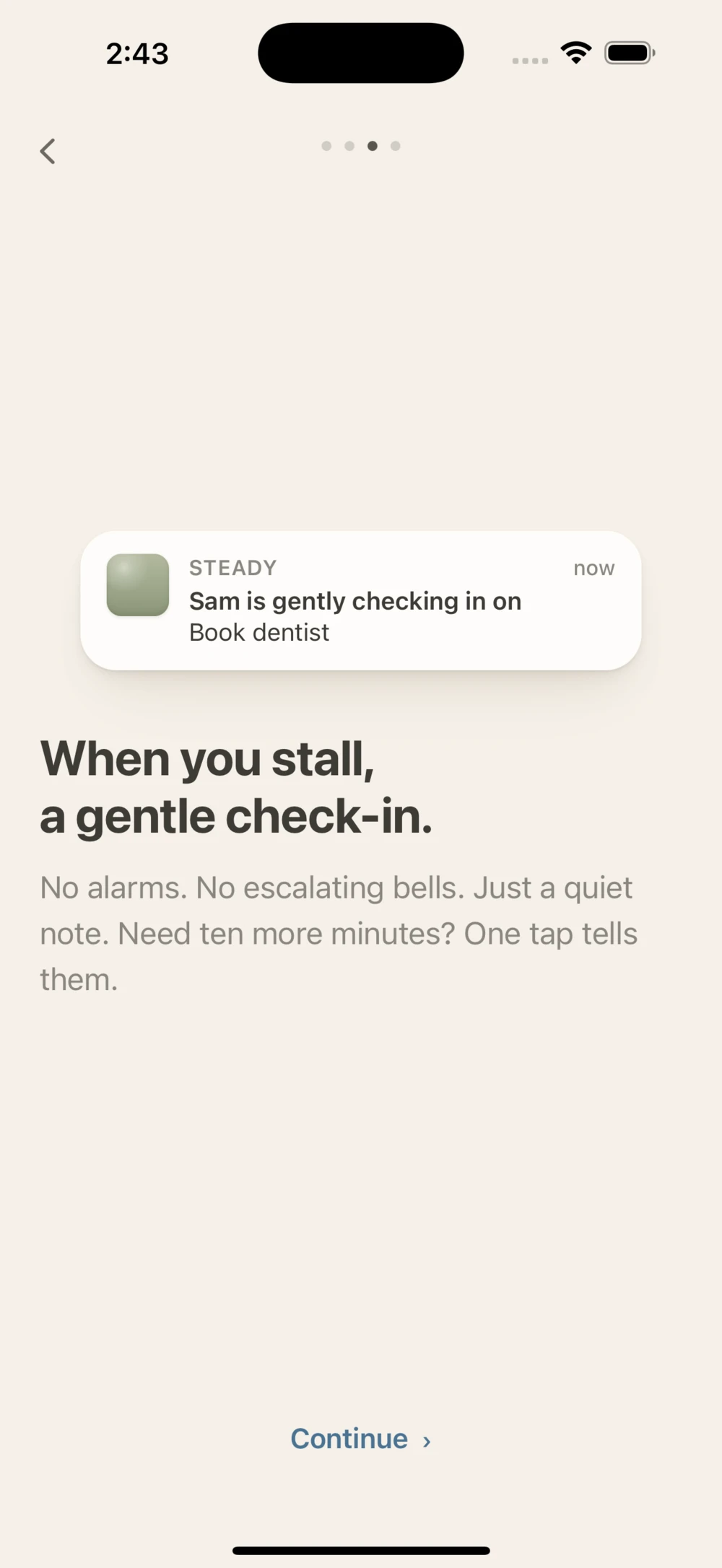
When you stall, a gentle check-in.
When you drift, a gentle nudge.
“Stall” sounds like a breakdown. “Drift” sounds human, and it’s easy to come back from.
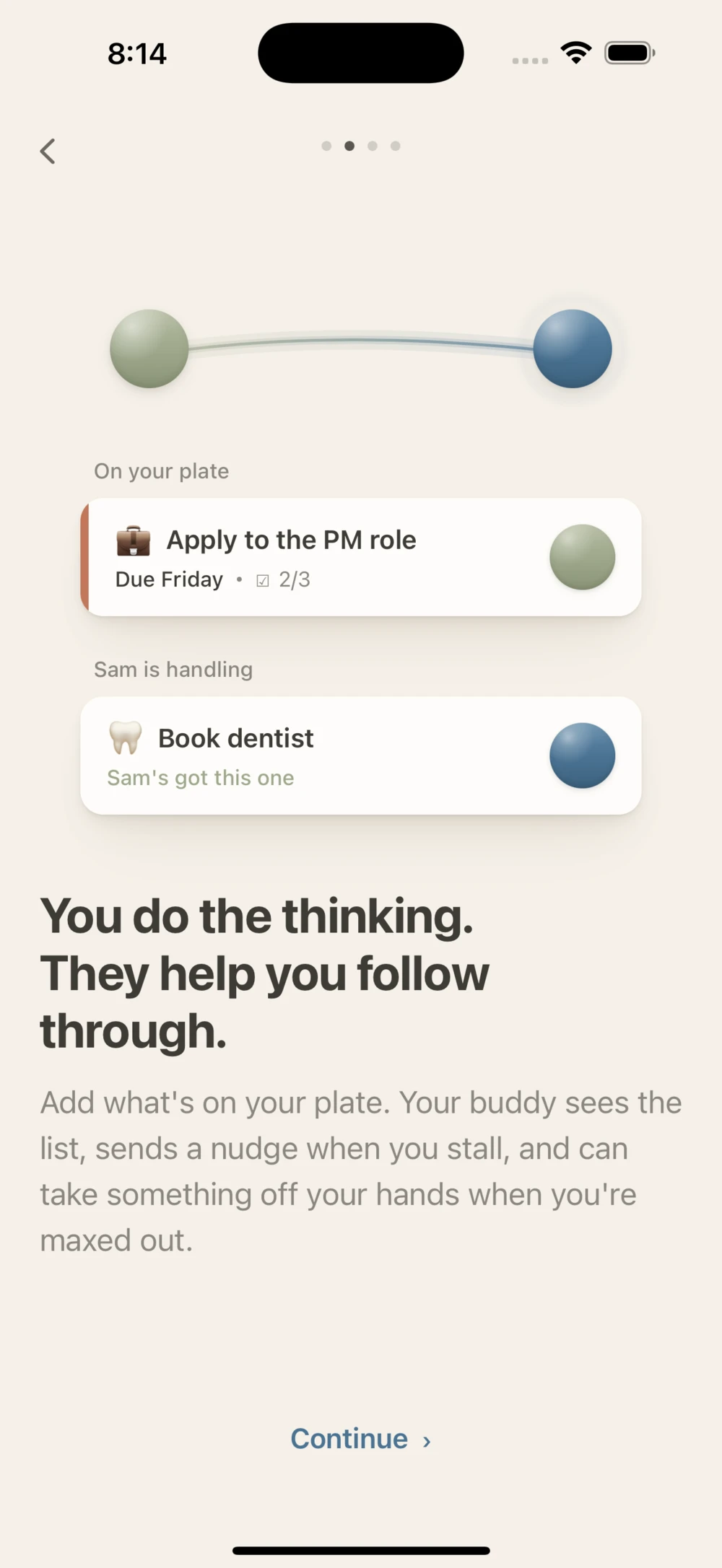
Add what’s on your plate. Your buddy sees the list…
Your plate is yours to fill. Your buddy can add to it too.
Ownership comes first. The list belongs to the Explorer before anyone else touches it.
The look had one job: feel like a calm room, not a dashboard.


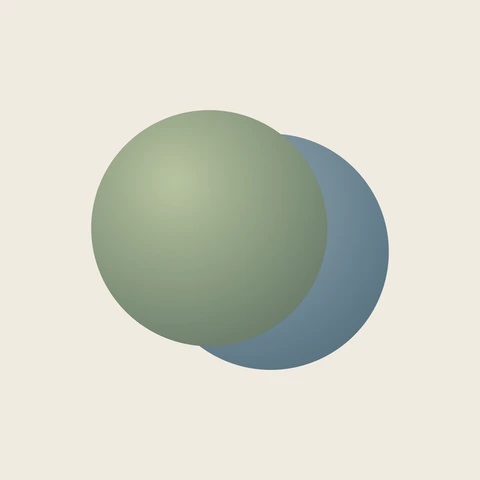
Two overlapping spheres, one for each person. They overlap on purpose: a pair, not two separate people.
Both are lit from the upper left, like glass under a window.
The first icon was a single wave, like the thread that joins the two people on the home screen. The shipped icon shows the two people instead.
Muted, warm, and slightly faded, closer to ceramic glaze than to a tech logo. Nothing is pure white or pure black. Anything urgent turns warm coral, never alarm red.
#4A7393#9EA88C#F5F0E8#FDFCF9#C2785A#6B7F52#C4697CBougainvillea only shows up for celebrations, and rarely.
At the top of the home screen, a line joins the two people. It’s alive. It sways gently on a normal day. When tasks go overdue, it flattens and tightens. When the pair goes quiet, it fades, but it never disappears. When a task changes hands, a small light travels along it.
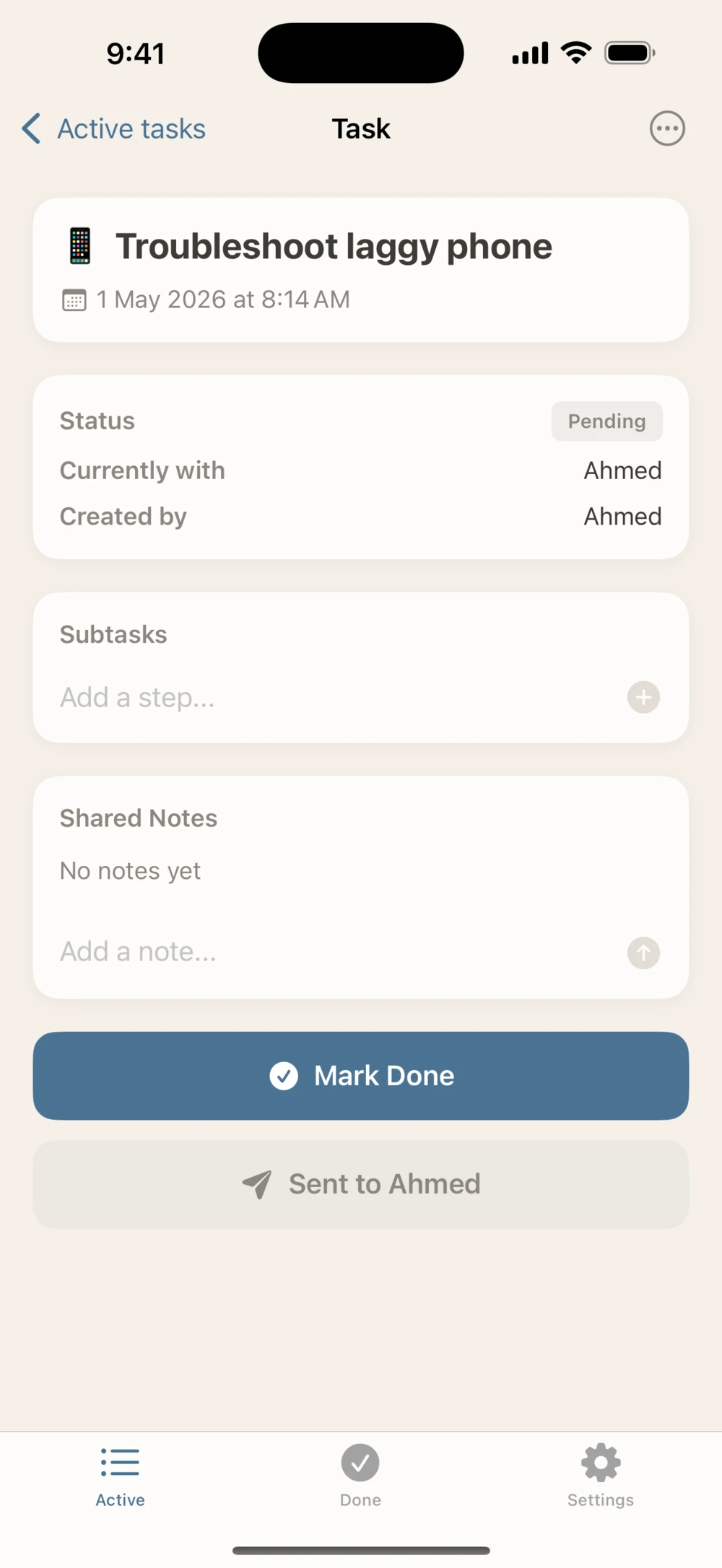
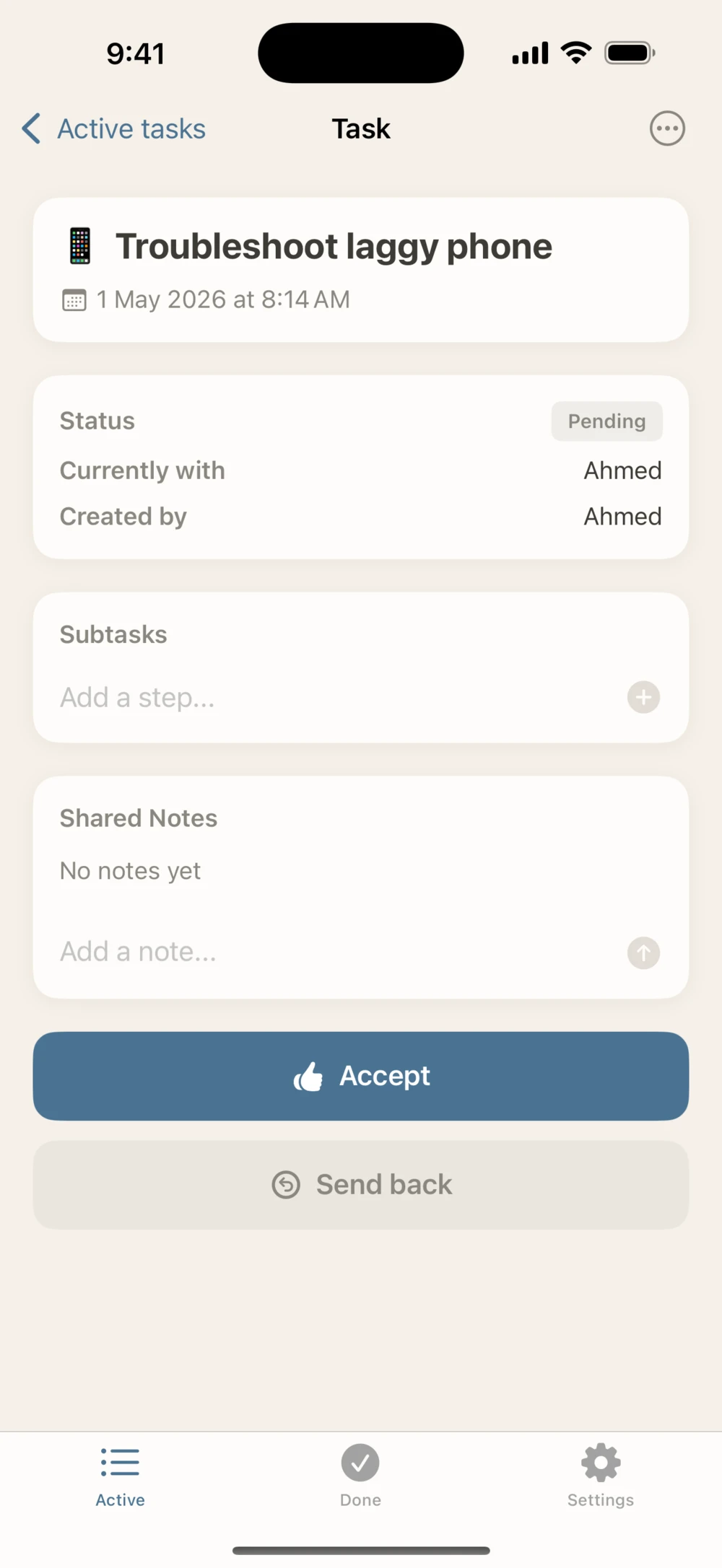
Try it:
Both people look at the same task, but each sees only the buttons that fit their role.
The Explorer can mark it done or hand it over. The Anchor can accept it or send it back. Nobody has to wonder whose move it is.
Seven screens, one sentence each. In every headline, one word is set in a warm serif: the word that carries the feeling.
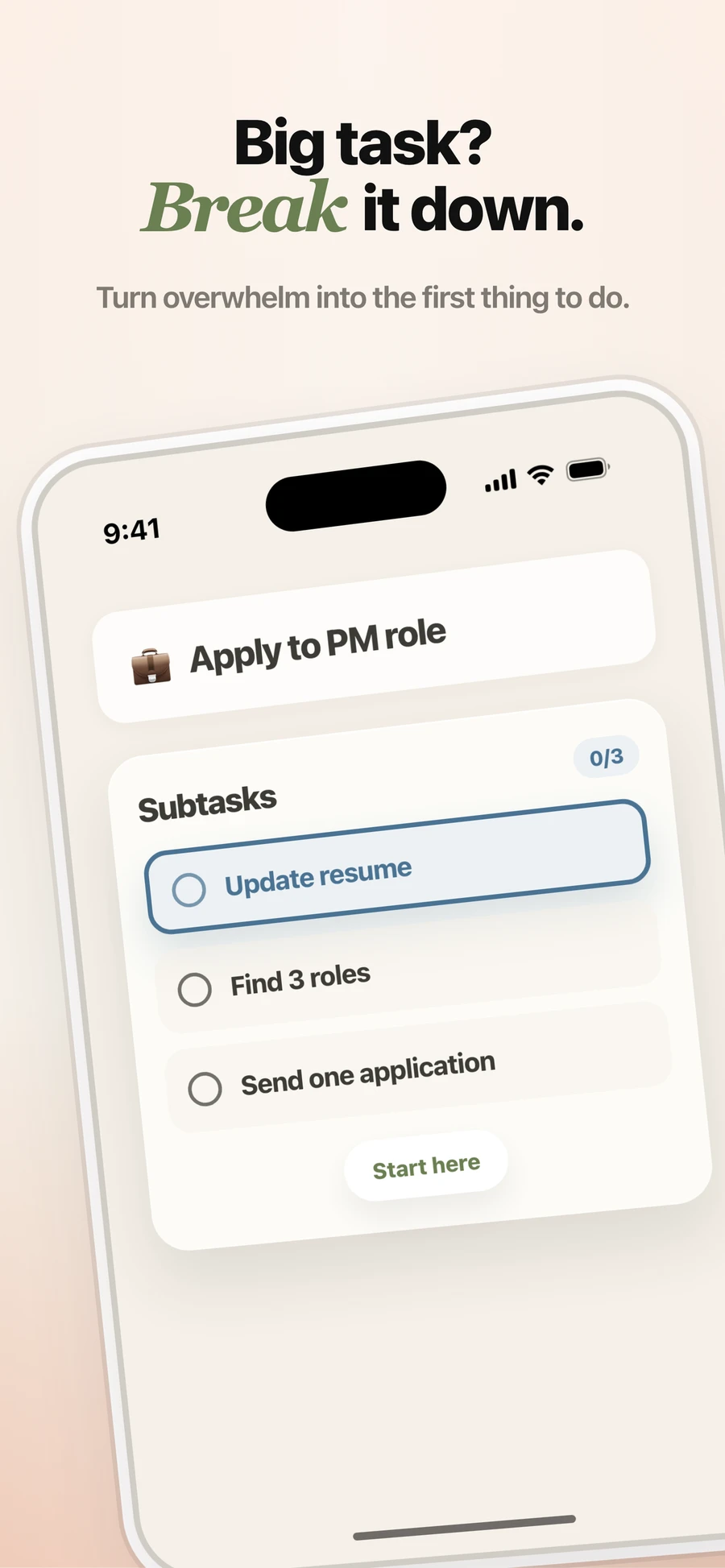
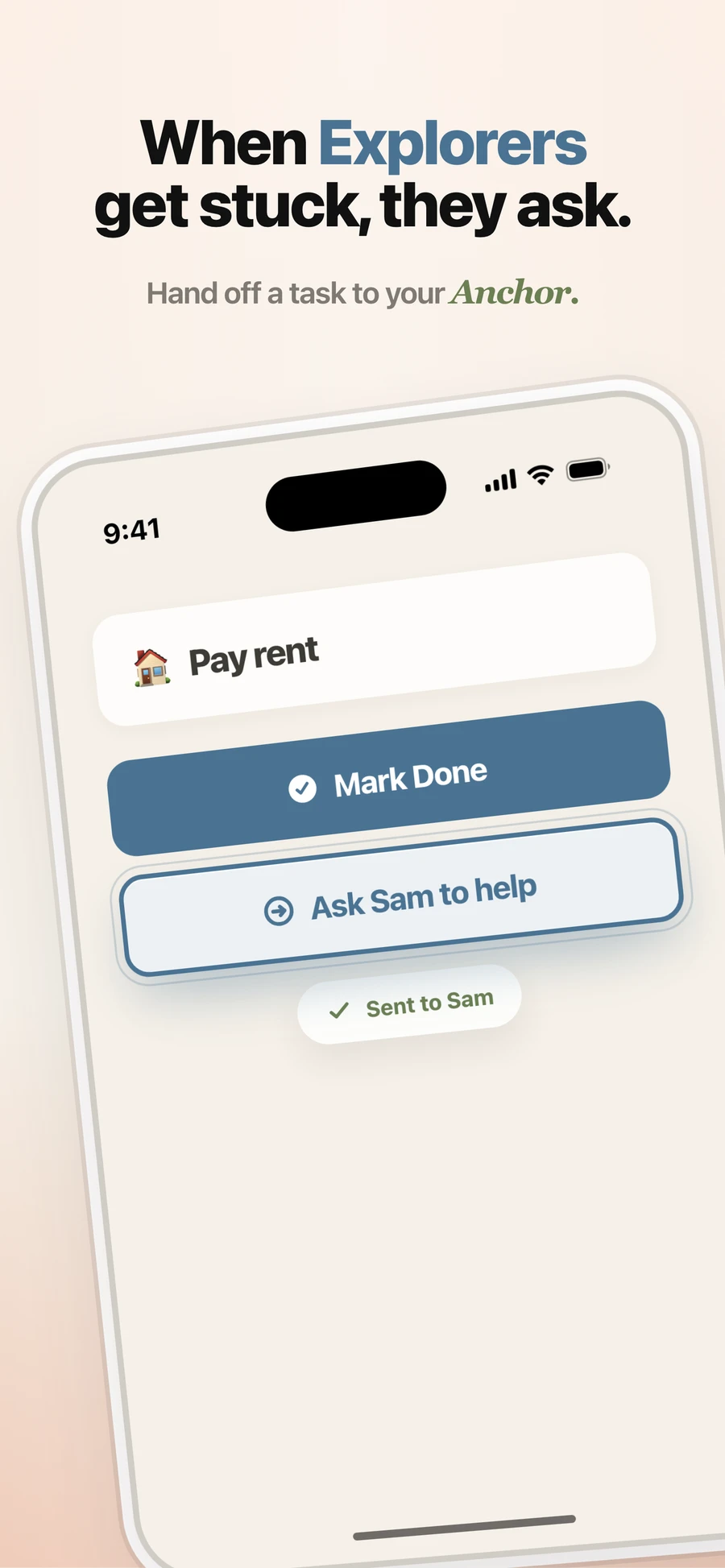
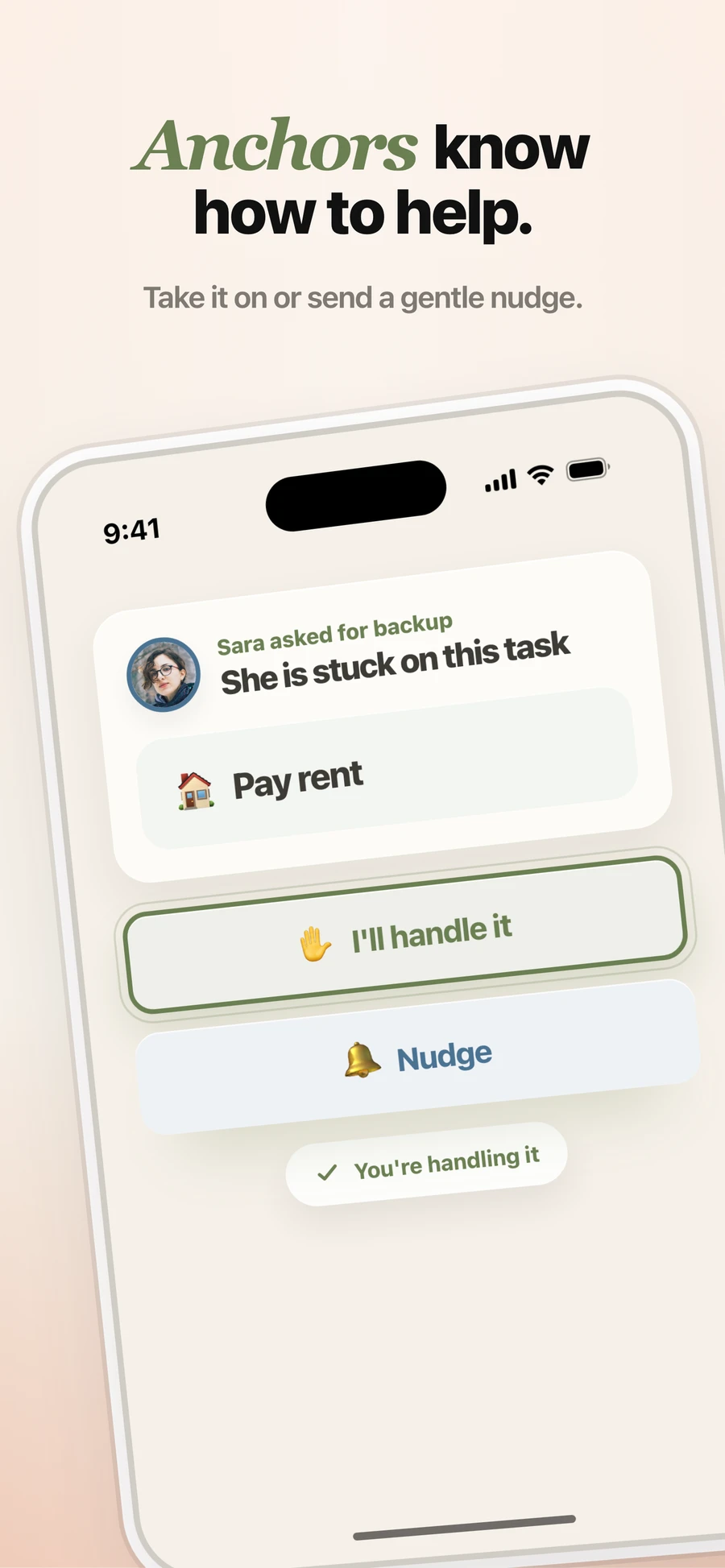
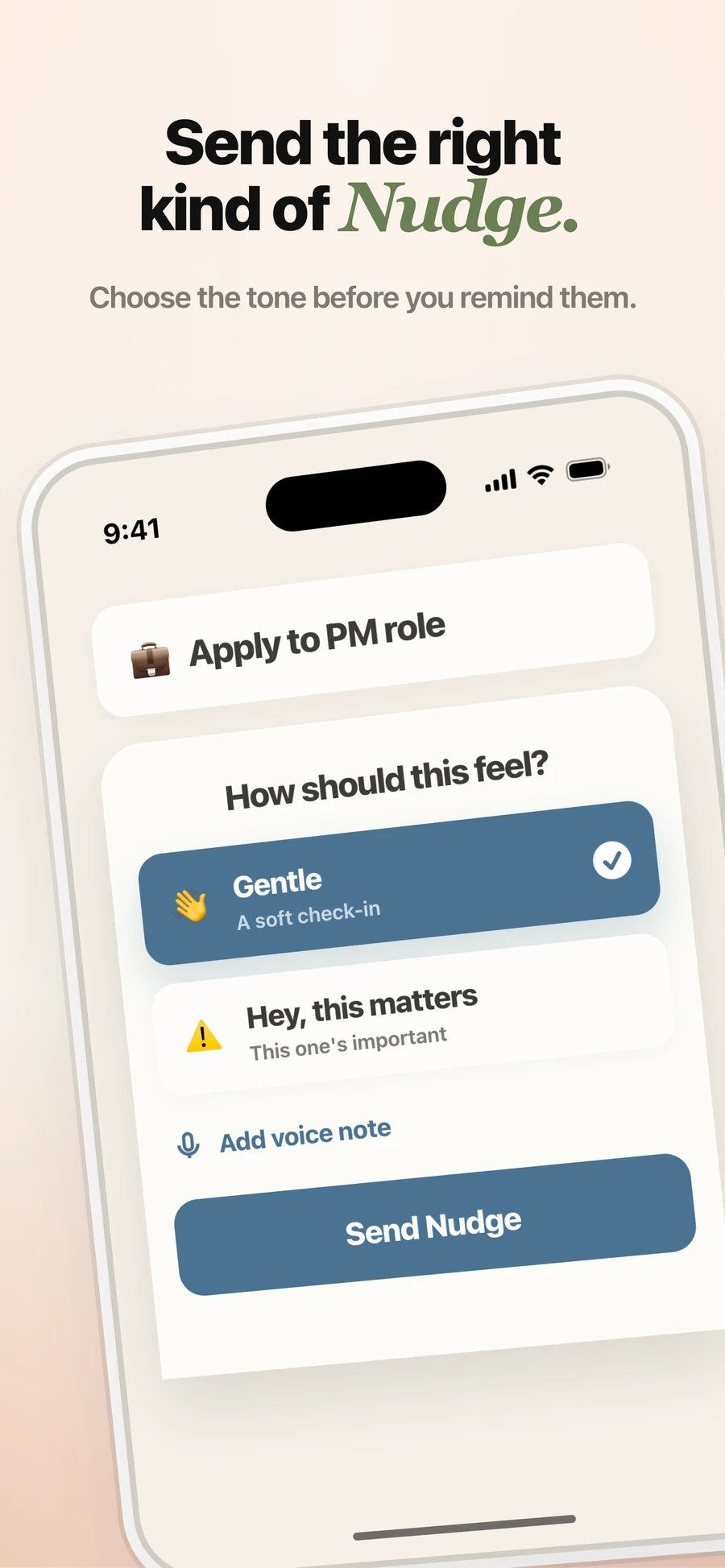
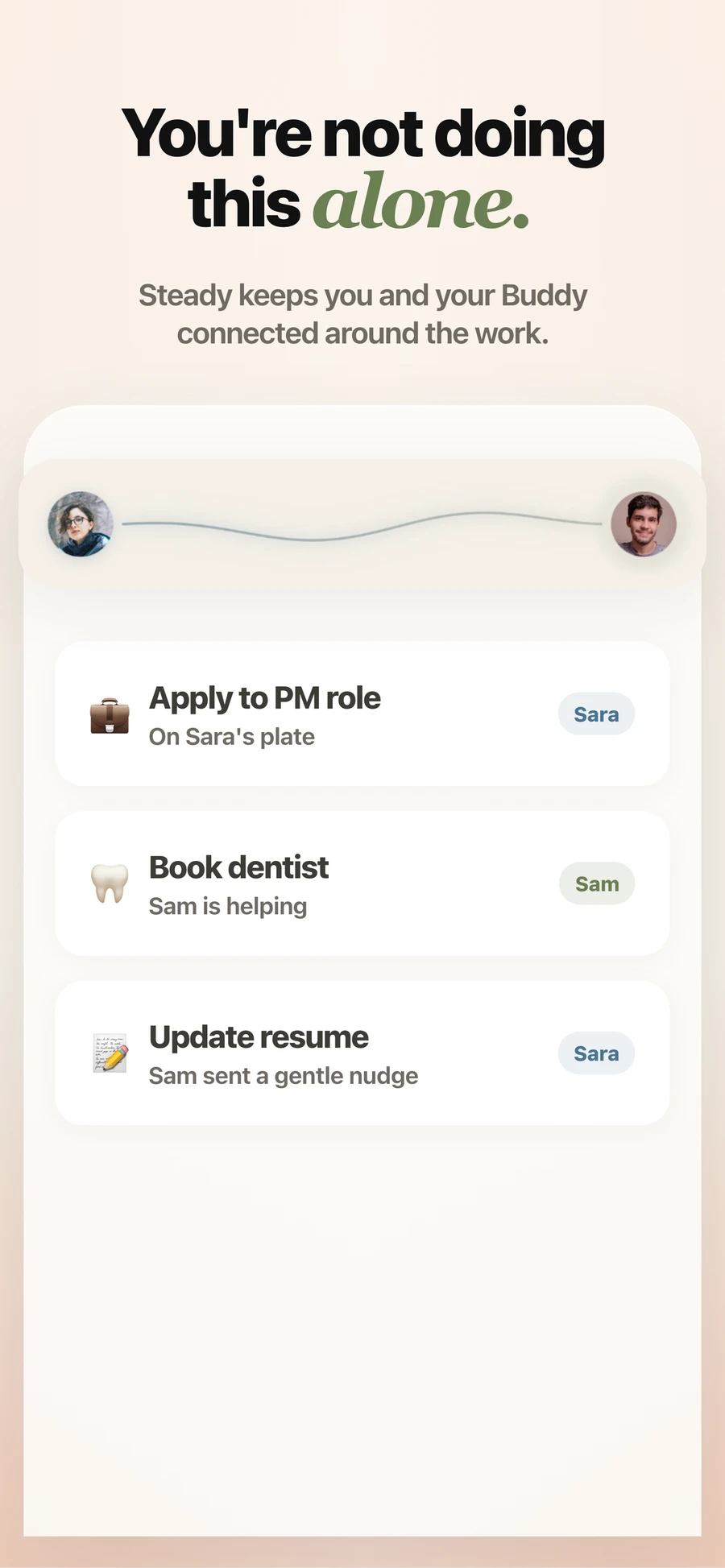
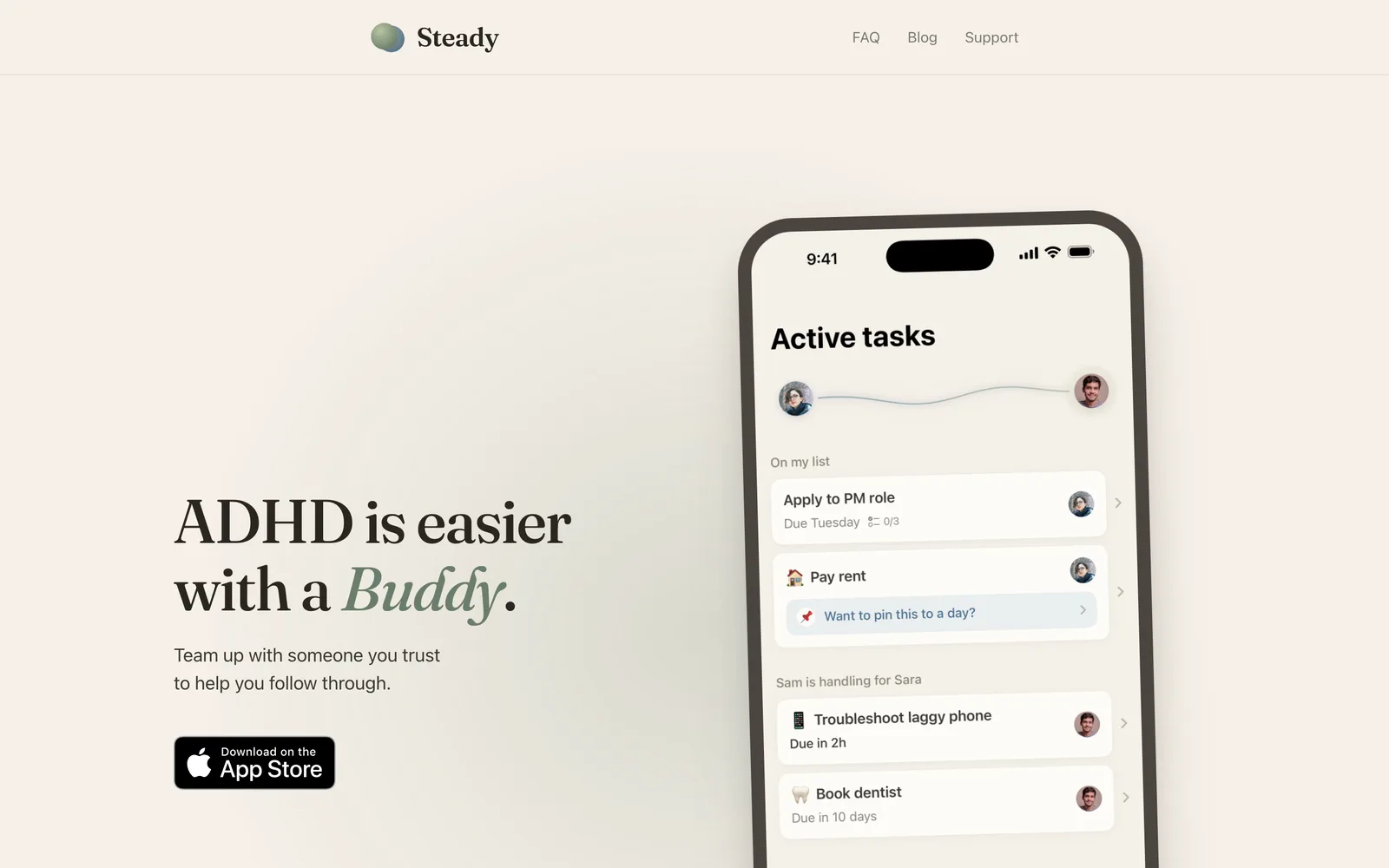
The website speaks in the same voice as the app, and opens with the same sentence: “ADHD is easier with a Buddy.” It also hosts the essays I wrote about why the app exists.
I built Steady myself, from the first prototype to the App Store.
The iPhone app is written in SwiftUI. A Firebase backend keeps both phones in sync and sends the notifications. It took about 250 commits.
The hardest part wasn’t a screen. It was privacy. Two people share one space, so a 1,000-line set of rules decides who can see and change what.
next
Handit